| Scots broom |
|
(Aka Cytisus scoparius)
The plant was introduced to Savary in about 1914, and in many areas, such as South Beach, it is the dominant cover on the slopes. According to Jim Spilsbury, in the 19-teens, the island kids were organized by Jesse Williams, an early cottager, to plant it all along the cliffs. "One year he brought up a bunch of broom seedlings and he gave us all sharp pointed sticks and a sack of broom and sent us out to plant in lines down the slope. British admiralty charts showed 'remarkable white sand cliffs,' since become completely green with our broom." (Source: Spilsbury's Album, p 31) 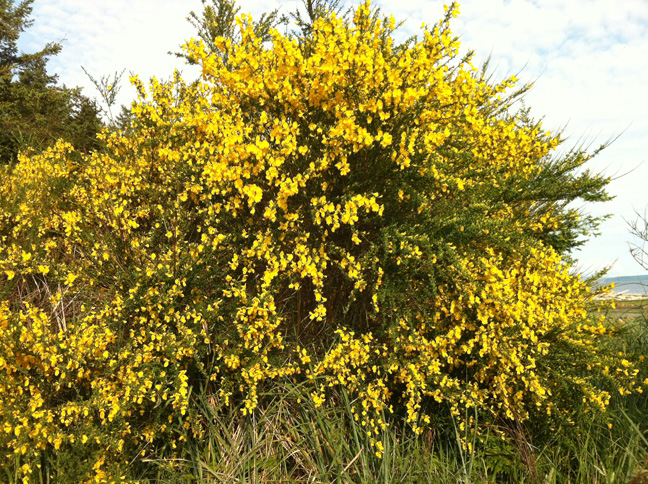 A June bloom of duck-bay broom Its intended role was to be a bank stabilizer; however, people almost immediately noticed that it displaced native plants. For example, in his 1931 account of Savary Island's ecology, R.S. Sherman wrote: "If it could be confined to the steep sand-slopes of the south shore, this shrub might in time vindicate its existence and the wisdom of those who introduced it; but, unfortunately, it has invaded the interior of the island where it is becoming a menace to our native flora." (Source: The Ecology of Savary Island, Sherman) Notes 1. For a complete and detailed description of this shrub, click here. 2. On a more positive note: On the slopes above South Beach, numerous plants — mostly weed species — grow beneath the broom: for example, field chickweed (Cerastium arvense), entire-leaved gumweed (Grindelia integrifolia), hairy cats-ear (Hypochoeris radicata), yarrow (Achillea millefolium), cleavers (Galium aperine), miners-lettuce (Claytonia perfoliata), sheep sorrel (Rumex acetosella), chickweed (Stellaria media), dovefoot geranium (Geranium molle), bull thistle (Cirsium vulgare), purple dead-nettle (Lamium purpureum), sweet vernalgrass (Anthoxanthum odoratum), orchardgrass (Dactylis glomerata), and trailing blackberry (Rubus ursinus). (Source: Thurber Report (2003) ) 3. According to Ian Kennedy, "Frankie Keefer later sent to England for English broom seeds. The red in the English broom easily differentiates from the yellow Spanish variety, but botanists claim that 5 different kinds now grow on the island." (Source: Kennedy (1992), p 75) |
| Categories: shrubs flora |
