| ancient dunes |
|
Several studies have been made of Savary's dunes. Here are links to a couple of them:
(1) The Thurber Report: Savary Island Dune and Shorelines Study, Strix Environmental consulting (2003) Here's a quote: "The Savary Island dune complex is considered the greatest remaining example of dunes within the Coastal Douglas-Fir biogeoclimatic zone (CDF) (Roemer 2000) and one of the best examples of coastal sand dunes in Canada (Dunster 2000). Other dunes occur within the Coastal Western Hemlock biogeoclimatic zone but these support different vegetation assemblages and associations owing to differences in climate (Roemer 2000)." (2) Sand Dune Ecosystems on Savary Island, B.C. with particular reference to DL 1375, Katherine Dunster (2000) Notes 1. The BC Ministry of Environment did a study of Coastal Sand Dune Ecosystems in British Columbia. Click here to read it. Here's an excerpt: "Because beaches and dunes are built from the shoreline inward, a walk inland from the water through the dunes and into the forest is actually a walk back in time. As dune plants grow and die, and their remains accumulate in the soil, both the nutrients and the water-holding capacity of the sand increase. The further back you go in the dunes, the better the soil gets. The change is relatively small but it makes it possible for somewhat less salt-hardy but more competitive species to establish in the area." 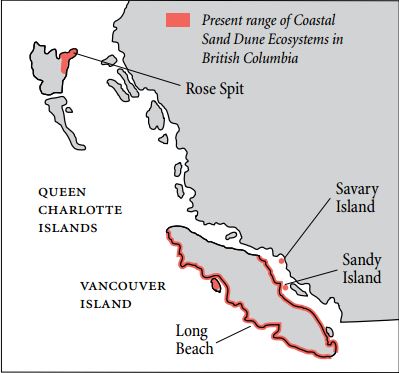 |
| Categories: geography documents |
