| Mace Point |
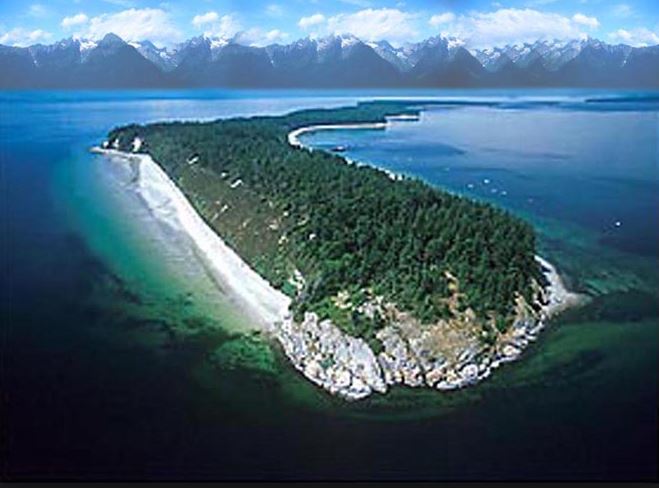 Mace Point and South Beach The rocky point that is the eastern tip of the island: It is the only outcropping of bedrock on the island, and it forms a nine acre coastal bluff headland that supports a great diversity of plant species. It used to be called Green's Point, but it was renamed (in April 1945) for Bill Mace, a Powell River carpenter who built the MacMaster log cabin in 1934. 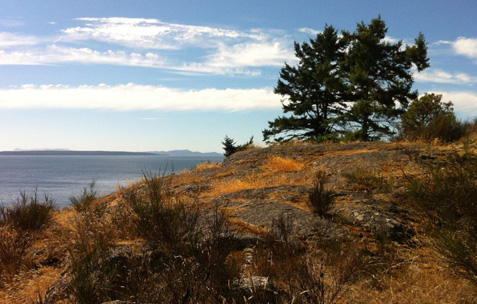 The view from Mace Point looking towards Harwood and Texada Islands The only recorded garry oaks on the island are located at Mace point. Savary Island is close to the northern limit of this species’ range. [I've tried several times to find these Garry Oaks but haven't had any luck. If anyone has a picture of them or can give me directions, please let me know.] 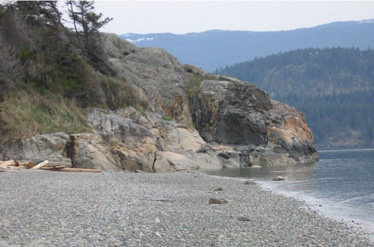 Mace point seen from South Beach. Check out that awesome granodiorite bedrock. The bedrock is granodiorite [a coarse-grained igneous rock] with exposed late basaltic dykes . 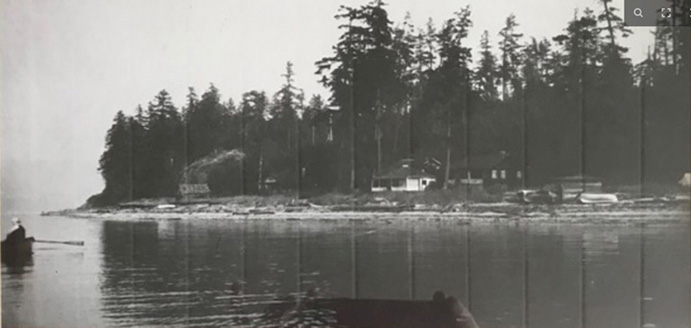 Mace Point in the 1920's. In those days it was called Green's Point. Taken sometime in the mid-1920’s, from left to right the structures are: (1) the remnants of Jack Green’s cabin (2) D. Ogilvie's cottage (3) Elmer Lee's cottage, which at the time was also known as The Love Nest. Norma Wood, Elmer Lee's daughter (thus perhaps herself a product of The Love Nest), took over the property sometime in the 1980’s (4) Rui Shearman's cottage. His nephew, Daryl Duke, took it over in 1982. Rui Shearman was the nephew of R.S. Sherman of Sherman Walk fame. Notes 1. "Millions of years ago magma in the earth’s crust melted domes into the subsurface base of bedrock covering what we now call the Strait of Georgia. Erosion over many thousands of years has exposed the tops of some of these domes, such as at Green’s Point. These domes consist primarily of granodiorite bedrock which weathers slowly to comparatively large crystals of quartz, feldspar and hornblende. Consequently, soil accumulates only in localized pockets, and any available soil moisture is quickly lost. These dry conditions and low nutrient availability cannot support trees. Grasses and wildflowers thrive here in the early spring when the soil pockets are still saturated from the winter rains. Over time, these herbaceous ecosystems add organic material to the developing soils, and shrubs and trees begin to move in. Such woodlands are a mosaic of trees and shrubs, which provide habitat for numerous bird species. The cracks and crevices of Green’s Point provide habitat for ground-dwelling snakes, small mammals and insects. Herbaceous and woodland ecosystems are particularly vulnerable to overuse, as shallow soils are easily eroded and slow to recover. The disturbed soils are readily invaded by non-native plants, which then inhibit the growth of native plants. Past sheep grazing at the Point is evidenced by the amount of introduced grasses present today. (Source: Sensitive Ecosystems of Savary Island - Carmen Cadrin and Larry Lacelle) 2. According to KnowBC: "Mace Point (49˚57'00" 124˚46'00" NE tip of Savary I, NE end of Str of Georgia). William Arthur Mace (1879–1975) was born in NB but moved with his family to Vancouver, where he married Laura Josephine Ibbotsen (1886–1969) in 1907 and worked as a farmhand and a carpenter. He and his family arrived on Savary I in 1913 to build a hotel for his brother-in-law, Savary developer Harry Keefer, and decided to settle there. Over the years, Mace constructed many of Savary’s cottages, and his descendants became well established on the island. The point was formerly known as Green Point after Savary’s first white settler, John Green (1817–93), who built a trading post nearby in 1886 and was murdered, along with his partner Thomas Taylor, in the course of a bloody robbery by Hugh Linn. Linn was the son of the former Royal Engineer who gave his name to Lynn Ck in N Vancouver. He was eventually tracked down and captured on Shaw I in Washington state, then tried at Victoria, found guilty and hanged for the crime in 1894. 3. 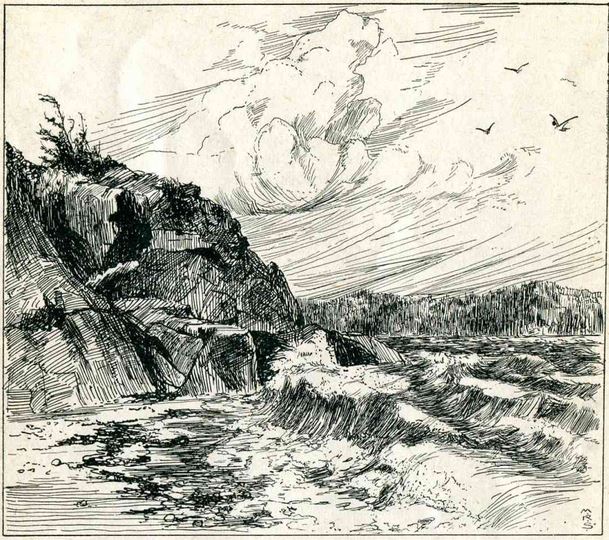 "Mace Point" by Maud Rees Sherman (1900 - 1976) "This drawing by Maud Rees Sherman was published in the April 1922 issue of School Days magazine. It is a view of the east end of Savary Island, looking eastward at Mace Point … on the south shore, Malaspina Peninsula on the mainland in the distance." - Gary Sim (Source: Sim Publishing) |
| Categories: places names |
