Life
on the Ragged Edges
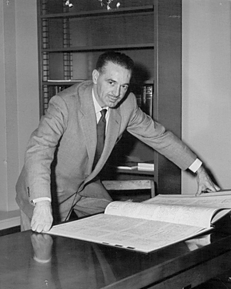
A Memoir by James Arthur Steeves (1908-1985)
Introduction
When my father
died in 1985, my mother went into shock and I—the only child—had to take care
of all of the arrangements. As I had a fairly-demanding job at the time, this
became one of the busiest periods in my life. In fact, I don't remember it very
well. Twelve years later, I was emptying out some boxes that had been sitting
around in our attic for a long time, when I came across the one that contained
my Dad's stuff. I hadn't opened since I'd filled it just after the funeral. In
it, I found several binders; one of which contained the following memoir.
I had forgotten
all about it; in fact, I had no idea that it still existed, but when I pulled
the ring-binder out of the card-board box, opened it and began skimming, a
35-year old memory of my Dad sitting in his basement office, furiously
two-finger typing away at his "book" came back to me vividly. Over
the next few nights, I read it through, and I enjoyed it so much that I decided
that I wanted my kids to read it—what a great way to get to know the
grandfather they had never met.
With this in mind,
my wife and I decided to—in our spare time—enter the complete text of my Dad's
white-out stained, barely-legible memoir into our computer. This took about a
year-and-a-half. The result of our labour is the following 70+ pages. It tells
of my Dad's life as a boy in Moncton during the First World War; some of the
adventures he had while living in the US and in Western Canada in the 1920s;
and, finally, it touches upon the beginnings of his career in the RCMP at the
start of the depression. My Dad was no professional writer, but I find his
stories quite funny—I'm biased—and I hope they convey the same sense of
excitement in print that they did 40 years ago when he told them to me as
bed-time stories.
Jon Steeves
1999
Chapter 1—A Kid in Moncton
Almost drowned
My
older brother Frank and I were the two surviving sons of Arthur Wellington
Steeves and his wife Adeline Steeves. Frank and I first saw the light of day
exactly eleven months apart in the Green House at the foot of Joudry’s Lane in
the city of Moncton, New Brunswick. Frank was the apple of mother’s eye, and
excelled throughout elementary school. At the age of sixteen, he graduated with
the highest honours from senior high.
My
father’s people descended from that hardy pioneering stock of German-Dutch
immigrant farmers who settled, with their scanty possessions, along the rich
farm lands bordering the Petitcodiac River in the year 1766. In 1966, the
resulting generations of the original seven Steeves’ sons in their
tens-of-thousands celebrated the family’s 200th anniversary at the town of
Hillsborough in Albert County.
During
my youth, Moncton was recognized as one of most important functional and
administrative citadels of our nation’s two giant railroad systems. It became
known far and wide as the hub of the Maritimes, with its myriad of steel
railroad tracks converging into the city’s railroad yards, much as do the
spokes attached to the hub of a wagon wheel. Day and night, passenger and
freight trains were constantly coming from and going to all parts of the
western hemisphere.
Joudry’s Lane was
named after my mother’s people—the Joudry’s. When I was a boy, her brother,
Uncle Larry, owned a mile of hayfields extending below the Green house to the
pumping station near Hall’s Creek—this creek’s adjacent forests, marshes, and
swimming holes served as an excellent proving ground in molding the character
of a nine year old boy gifted with the reckless and determined spirit that
compelled him in his manhood to pursue the pioneering heritage of his
adventuresome forefathers.
In addition to the
distinction of it being a railway center with a permanent payroll, Moncton was
important in other respects: it had its own whore-houses, gambling joints, and
speakeasies down by the river on Main and Pearl streets. The Petitcodiac itself
possessed a virtue because there was only one other like it in the whole world.
It had a tidal bore. People came from all over to see its tidal bore action
twice daily. From the city’s benches in the summer green parks with its
band-stand that bordered the river, tourists would watch in awe as the rising
spate of flood waters reversing the tides, swept tempestuously up around the
bend of the Petitcodiac River from the Bay of Fundy, churning the advancing
currents into a dangerous undertow.
The River also
possessed a dangerous vice—quicksand. Many a weeping parent could testify to
this fact. The boys I chummed around with in my neighborhood had a healthy
respect for the river, and were more interested in the swimming holes along one
of its tributaries, Hall’s Creek. During the fall and early spring months, the
tidal bore from the Petitcodiac flooded the mile wide marshes on both sides of
Hall’s Creek, and far across the rising escarpment to the blueberry plains on
the outskirts of the hamlet of Sunnybrae.
Beyond the city’s
pumping station and the marshes of Hall’s Creek—with its skyline of spruce,
maple, and birch—was the pipe-line path out to the reservoir’s three brooks.
There, as a boy, I caught hundreds of trout with my good friend Edward Magee. I
always called him Edwar and he called me Jimmy. His brother Val and my brother
Frank were inseparable. Edwar and I were each nine years of age then. Edwar and
I were always up to some mischief, and we often caused our parents considerable
anxiety, so much so, that there were times when we provoked them so much that
each of us would be punished with a good old-fashioned licking from our Dad’s
razor straps on our bare backsides.
When we were
9-years old, Edwar and I built a row boat and tarred its bottom to keep it from
sinking. Edwar’s father had a beautiful shot gun and our object in building the
boat was to shoot the geese and ducks, which each spring always fed in the
middle of the mile-wide marshes. In the early spring when the Petitcodiac
river’s tidal bore came surging into Hall’s Creek, these marshes became
drowning deep . To get even a single shot at our game, we had to shove off in
our row boat in the early dawn while it was still dark enough not to disturb
them.
On the high ground
close to the edge of the Creek just below the pumping station where we proposed
to launch our boat, we paused for a breather at the pumping station. This huge
building contained the turbines which pumped Moncton’s water supply from the
reservoir five miles back in the forests. Everyone kept on the best of terms
with Bliss and Scotty, the engineers. There was always an apprentice on their staff
who was employed in working on the huge revolving wheels of the tremendous
engines that generated the electrical power to run the turbines. We were
friends with everyone there, and they were intensely interested in what Edwar
and I were planning to do.
On winter evenings
we would use their comfortable quarters as a haven for putting on our skates.
After we tired of skating or playing hockey on the marshes in the daylight
hours, both Edwar and I frequently engaged in a game of cribbage or hearts
forty-five with Bliss and Scotty. At these two games, my constant companion and
I became experts. During our summer holidays, the pumping station was one of
our daily haunts.
I have often
reflected upon those memorable years as an adolescent boy in some of the far away
places I have traveled; reflected upon them with an inner smile and a
reminiscent glow in my consciousness. During our school holidays on those sunny
summer afternoons, after Edwar and I had returned from the swimming hole or on
our way back from fishing trout in the three brooks by the pipe-line, we always
stopped at the pumping station to while away the rest of the afternoon with our
engineer friends. Sometimes we were late for our evening meal because we were
reading their newest detective magazines—reading and listening to the constant
hum of the turbines pumping Moncton’s water supply.
Before dawn on
that morning’s jaunt, while carrying our row boat on our shoulders, Edwar and I
stopped at the pumping station to tell Scotty and Bliss what we proposed to do.
Their cheerful demeanor changed to fatherly concern, and both pleaded with us
not to go because they felt it was too dangerous to venture out in the marsh’s
dark waters amidst the floating spring ice. Completely disregarding their sound
advice, we continued on our way, and within half an hour had rowed our boat
into the middle of the mile-wide marsh. Just as the early light of dawn was
beginning to break, we were within shotgun range of the geese and ducks.
At this point,
unfortunately, our boat started to leak and rapidly fill with water. Edwar
bailed furiously with his cupped hands, while I stood at the boat’s stern, up
to my knees in water, shotgun braced against my shoulder. Just as I pulled the
shotgun’s double triggers at the geese less than fifty feet away, our boat sank
stern first. We both sank to the bottom as our rubber boots filled with water.
Kicking off the boots, we rose to the surface, striking our heads on the tarred
bottom of our sinking boat. Fortunately, both of us were excellent swimmers,
even with our clothes on, so we struck out for the blueberry plains almost half
a mile away.
It took quite a
while but, eventually, we both made it to the opposite shore of the marshes
and, completely exhausted, climbed up the escarpment to safety. Evidently, our
friends at the pumping station, were watching our progress with binoculars, so
they saw the boat go under with the two of us in it and, not seeing us emerge,
thought we had drowned. They immediately telephoned our homes and the city police
force. At the same time, Edwar and I were struggling up a path through the
bushes on the blueberry plains. While doing so, we thought we detected quite a
lot of unusual activity on the other side near Hall’s Creek Bridge by the
pumping station. Later, we were found out that it was the police with their
rubber rafts and grappling hooks vainly trying to recover our bodies that they
thought were at the bottom of the marshes.
At this time
however, Edwar was more concerned about his father’s expensive hand-carved shot
gun, which now lay somewhere at the bottom of the marsh. We also thought we
were in for a good licking from our fathers who when they saw that we were
building a boat, had warned us to stay away from the marshes. With our clothes
soaking wet, we trudged through Sunnybrae on our five-mile journey home.
Finally, we reached my house. But before we went in, we discussed the events
and decided that we needed each other’s moral support to face our parents. Our
plan was to go to my home first and then to Edwar’s which was near by, so we
both walked up the front path between the lilac bushes and entered my house
through the unlocked front door.
Our feet were very
muddy. In fact, to this day I still remember the footprints we left on my
Mother’s clean floors as we moved silently down the hallway and approached the
door that opened into our living room. We both stopped and listened outside the
closed living room door. Inside we could hear the grief stricken voices of our
people. When we opened the door, we saw all the women crying their heads off.
Beside my father and mother and Edwar’s mother, there was Mrs. Watson Lutz, my
mother’s best friend. At the time, Edwar’s father, who worked for a tobacco
company, was out of the city on business.
You can imagine the
picture we presented. Soaking wet and covered with marsh mud from head to toe.
With joyful exclamations of the sheer exuberance in seeing us alive, they all
started hugging Edwar and I and soon got the full story of our harrowing
experience. In turn they told us that when we arrived, they all had been
waiting for the Police to notify them that our bodies had been recovered from
the marshes. Both Edwar and I changed our clothes, while our mothers and Mrs.
Lutz prepared us a sumptuous repast of steak and onions and fried potatoes,
which surely tasted good after that icy swim and tiresome tramp across the
fields.
While Edwar and I
were gobbling our food down in the kitchen, my father looked at us with what I
believe was a glint of admiration in his eye—I think that this was probably the
first time he thought that both Edwar and I were capable of looking after
ourselves, despite our tender ages, in a dangerous situation when the chips
were down. Neither of us received a licking and when Edwar’s father returned
and was told about what had happened, he never faulted Edwar for losing his
prized shot gun.
A Visit to Aunt Maud’s
My father’s people
were farmers from Salisbury on the upper Petitcodiac River. They were a large
family, mostly boys, who in their prime were all over six feet tall and weighed
around two hundred pounds. After father’s parents died, the farm was inherited
by his brother Jim, who was both the eldest son and a courtroom Judge. After
that, my father moved to Moncton and got a job with the railroad. Eventually,
he married my mother and Frank and I were born eleven months apart. The house
that we were born in had been my mother’s family home. When her parents died,
her brother, Uncle Larry, gave her the house and some adjoining acreage as
mother’s wedding present.
One of my first
memories of the old Joudry home was that it was painted white. It was later
repainted green with white trim. We all thought that the new color blended in
nicely with its lawns and purple lilac trees on either side of our front
entrance. There was also a large poplar tree on the lawn; the hammock that we
used to swing on in summer time was attached to it.
During summer
holidays, when Frank and I were in our primary school grades, Mother would take
us to Campbellton on the Ocean Limited to visit Uncle Larry and our cousins
Elizabeth and Alice Joudry. Although both Elizabeth and Alice had graduated as
trained nurses, neither of them had pursued that profession. Their father was
well off and the girls ran the house for him. Uncle Larry’s wife, my Aunt, had
reputedly died of a broken heart after losing her only son, Jim, in the First
World War. At the time of our visits to Campbellton, Cousins Alice and
Elizabeth were about three times my age. This age difference was because my father
was over fifty years old when he married my mother—she was in her late forties
when she married Dad. I remember once telling my mother that if she hadn’t met
him, she would have ended up an old maid. This didn’t please her vanity very
much. Judging from the photographs in our home, mother was a very handsome
young lady in her prime.
I was nine years
old when we returned from visiting the Joudry’s that year—the same year that I
first met my best friend Edwar. It was also memorable, because during that
absence, Father repainted our house green and installed gas-heating. But what
made mother happiest was the newly installed indoor plumbing. The old woodshed
attached to the north end of our house that had enclosed the quadruple privy
had been dismantled and removed. In its place was an extension of my Dad’s
garden, and there I saw some gigantic pumpkins hidden behind gigantic pumpkin
leaves. Their size no doubt resulting from the garden’s plentiful human
fertilizer. Mother made some delicious pumpkin pies from those pumpkins.
My uncles, aunts,
and cousins on my fathers side were all farmers who either lived up at Boundary
Creek or even further up the Petitcodiac River, around Salisbury. There they
farmed the rich bottom lands along the river. On weekends, father would hire a
span of trotters from the local livery stable, hitch them to a covered carriage
with rubber wheels, and then drive up to Aunt Maud and Uncle Calvin Jones’
farm, ten miles away at Boundary Creek. This farm contained over two hundred acres
of the most fertile bottom land along the Petitcodiac River. Cousin Frank, and
Able and Minnie Jones were my other relations there on the farm.
Our family’s
visits to the farm at Boundary Creek were a cherished event. When we arrived on
Saturday evening amidst all the hectic activity at their farm house,
Father—with my help—would unhook the tugs from the carriage’s twin whiffle
trees and lead the team over to the watering trough; there we would remove the
harness and hang it up on the stable’s pegs, and then bed the horses down in
their stalls with straw, fill their mangers with hay, and their oat boxes with
a sizable feed of grain. When we finished, we would enter Aunt Maud’s spacious
kitchen and sit down to enjoy a delicious meal of brown bread and pork and
beans—with a generous slice of apple pie with home-made ice cream for desert.
They had that special dinner at my Aunt Maud’s every Saturday night.
Aunt Maud was my
Dad’s sister. She was big, buxom, and industrious, never idle a minute around
the farm, except on Sundays—the lord’s day—when both of our families attended
the morning service. On those occasions, my Dad always hitched up our rig and
we would follow the four seat carriage driven by Uncle Calvin, with Aunt Maud
beside him dressed in her Sunday best, and cousins Frank and Able in the rear.
Cousin Minnie remained at home to prepare the mid-day meal: on Sundays, after
attending church, we always had roast turkey with all the trimmings.
At church, there
would usually be about a hundred solemn-looking farm folk and their children
attending Sunday service. The local minister, a middle-aged man, wore long
side-burns and dressed in a black suit with a reverse white collar. For his
sermon, he would shout the wrath of God and the horrors of hell-fire at all the
sinners present; he delivered this with a powerful combination of conviction
and indignation. Right after he had finished, the deacons would pass the
collection plates.
One Sunday after
the Church service had finished and we were on our way back to Aunt Maud’s in
father’s carriage, closely followed by Uncle Calvin’s team, we stopped at the
gate of one of the neighboring farms. Inside the farm-yard, there was a big
yellow Guernsey cow pegged out on a thirty-foot chain. Though the cow was in
heat, she was doing her damnedest to avoid getting bred by a determined Jersey
Bull. After we had been watching this for a few minutes, my mother began urging
Father to drive on—“Arthur, think of the children”—but he ignored her; judging
from the big grin on his face, he was enjoying himself.
At that moment,
wearing a gingham dress, the neighbour’s wife appeared and approached the
Guernsey cow. When she was close enough, she carefully grabbed its halter shank
and used it to steady the cow’s shimmying rear quarters. The bull didn’t need
any urging and, sensing opportunity, immediately mounted the Guernsey and
plunged at her, but he missed the target and—deflected—shot a blast of semen
down the front of the neighbour’s wife’s dress.
My old man just
roared. I looked back at Aunt Maud and Uncle Calvin and they were laughing too,
so were my cousins. I wasn’t. In my nine years, I had never seen anything like
this. As we all watched the bull go at the cow again, pounding so hard that the
cow’s back knotted, I said innocently to mother: “Why is he hurting the cow?”
My mother replied firmly that I was too young to understand. Then, she gave my
father a dig in the ribs with her elbow and said, “Enough is enough! Let’s get
going. This is a fine spectacle for our boys to witness after leaving the house
of God.”
The Jones’ Farm
All my Jones’ cousins
were considerably older than Frank or I. In fact, we were just small children
when cousins Frank and Able were grown men who planted, plowed, and gathered in
the alfalfa crops with their father—my Uncle Calvin—who was a robust sixty
years of age at that time.
The farm buildings
were set apart at least a hundred yards from their large, attractive and roomy
house; it sat on the crest of a hill, commanding an unobstructed view of the rolling
rich farm lands, and of the Petitcodiac River in the distance. The whole Jones
family took great pride in their attractive flower gardens, which surrounded
the north side of their big white house with its red brick chimneys. Everything
was nicely landscaped, displaying that well-groomed look that comes with pride
of ownership.
From the sandy
road that meandered by my Aunt Maud’s farm and continued on towards Salisbury,
a casual observer couldn’t help but be impressed by the Jones farm’s fastidious
surroundings, so immaculately sub-divided by its three-tiered, white-line
fencing, containing romping mares with their foals. In addition, there were the
fenced-in cow-pastures with interlocking gates, which each opened to a
well-traveled cow path leading in a mile-long straight line from the River
below to the huge cow barn.
At the base of the
sandy road, an eight-foot high swinging gate, with its high arch designating
the identity of the Jones’ farm, one could see the big red hay barns with their
winches, pulleys, and tackles extending high up and out from where the pigeons
made their nests on the inside of the hay-loft roof runners. This practical
method of unloading the alfalfa into the hayloft bore mute testimony to the efficiency of the Jones’ profitable
operation.
On the lands not
used for pasture or alfalfa, many different types of root crops and fodder were
harvested and ground into silo feed for the fattening of the beef and hogs,
which were marketed in the city on week days. Scores of steers and hogs in the
outside feeder and finishing pens were continuously being readied for the city’s market.
My uncle was the
executioner, and in the killing room—as it was referred to—he severed the hog’s
jugular veins. After that, Cousins Frank and Able would force each pig’s head
into a large puncheon brimming with scalding hot water. It wasn’t a pleasant
sight to see or hear. Those poor hogs protested in unmistakable terms— on a
clear night you could hear them squealing a half a mile away.
One clear night, I
actually did hear their squealing from a half-a-mile away. That was the time my
cousin Minnie Jones asked me to go for a ride with her up to the post office to
get the mail. Cousin Minnie let me hold the reins while I sat on her lap. And
as a boy of tender age, I thought it very thrilling to be allowed to do so.
Minnie was in her mid-twenties and was a school teacher in the city during the
week. But on weekends, when she attended to many of the chores, she was
transformed into a very competent farmhand, . She was, also, as very
good-looking woman: beautifully proportioned and powerfully built, she had
luxurious golden hair that she combed up high. But, Cousin Minnie could handle
a pitchfork on a hay load with the skill of her older brothers.
From my point of
view it was on Saturday evenings at milking time that Minnie’s farming talent
reached their peak of excellent—I would join her in the barn, together with the
three Maltese cats. We all—those cats and I—greatly admired her dexterity when
milking time began: the efficiency with which she filled those brimming milking
pails, firmly clinched between her bloomered knees, drew the purring plaudits
of the farm cats, that Maltese trio who excitedly sat well within squirting
distance, with open-mouthed admiration as Cousin Minnie manipulated her nimble
fingers on the teats of the cow's udders, hitting the bull’s eye in the cat's
mouth every time.
When milking was
finished, the two-score pails brimming with milk were carried from the barn to
a meticulously clean adjoining out-building where the cream separators were
kept. Helping our three cousins, my brother Frank and I would turn the
handles, separating the milk into
cream, which was then placed into huge containers that Cousin Frank and Able
loaded into a buckboard. These containers were then hauled out to a raised
platform, where the city dairy truck picked them up and transported
them—together with others picked up along the route—to the Moncton Dairy. This
cream and milk was then delivered in pint and quart bottles to the people of
Moncton. The residue skim milk was greedily swallowed up by the hogs in the
feeder pens.
But the Jones'
farm was more that a dairy farm: my Aunt Maud’s pride was her large turkey
flock—and they could surely out run me most of the time. Usually, they would
run so fast with their clipped wings beating the air and the ground, in their
desperate efforts not to be caught, that some of the hens would commence
dropping big eggs while they ran. One Saturday afternoon, Aunt
Maud caught me chasing her turkeys. She hid in ambush and pounced on me from
behind the barn, just as I was ready to dive on top of the one that had the
biggest tail feathers. I wanted to take that big fan of tail feathers and hide
them somewhere in our carriage, and when I got them home, I was going to make a
real Indian head-dress, just like the one's that Indian chiefs wore, so I could
be the Indian chief when we played cowboys and Indians. But that scheme never
materialized, after Aunt Maud finished scolding me in loud angry tones, never
again did I bother my Aunt’s turkeys.
Typhoid Fever
The year that I
turned ten years old [1918] a flu epidemic spread through most of Moncton’s
schools. One afternoon, on arriving home from school, Mother said ”Jimmy, is
your school closed too? Frank’s is being closed because of the influenza.”
Frank and I went to different schools—mine hadn’t been affected yet. I replied,
“Yep, mine is too.” That lie almost cost me my life.
Later on,
mother—after realizing what school-closing implied—made a point of telling me,
“Jimmy, promise me that you won’t swim where the sewer empties into Hall’s
Creek.” I solemnly promised her I wouldn’t. The next morning, of course, I
headed across the hay fields to where the sewer empties into Hall’s creek.
When I got there,
several other kids were already swimming stark naked at a site we called Eel’s
hole; this was just below the place where the city’s sewer emptied into the
creek. In those brownish, turbulent waters, you would occasionally see stools
of human excrement swirling in the murky water’s undertow. The other kids were
playing a game that involved diving from a diving board anchored to the bank by
sand bags and seeing how far you could go under water before coming up for air.
After watching them for awhile, I joined in.
On about the third
or fourth time I did it, and after swimming a considerable distance under
water, I thought my lungs were going to burst, so in rushing to the surface for
air, I started swallowing water, and, unfortunately, swallowed a mouthful of
excrement. It tasted awful. Coughing, I crawled up the bank onto the shore, and
when I when I had my breath back, I started trying to vomit it up by putting my
fingers down my throat. This didn’t work. I suppose, someone who can swallow
feces without vomiting is going to have a tough time forcing himself vomit.
I was feeling weak
from all that, so I decided to put my clothes back on, and—it seems to me—that
I had just pulled my knee pants over my bare feet when I looked up and saw my
Mother. I’ve often thought since then that she had a sort of psychic intuition,
because she could practically read my thoughts at times. It was probably
through this inner sense that made her realize that I had disobeyed her and
gone swimming at Eel’s hole.
Mother gently took
my small hand in hers and walked me back to our green house on Joudry Lane. As
we crossed the fields, she kept repeating, “Jimmy, you promised me you wouldn’t
go swimming there.” Her unspoken fears came true the very next day—I became
awfully chilly—so she bundled me into bed under a pile of blankets. Also, she
filled our corked bean-crock with hot water, put it inside of one of my Dad’s
size 12 woolen socks, and placed it snugly under the blankets against my side.
By nightfall, the fever had worsened, so Dr. Price, our family doctor, was
called in. My temperature was 105. His diagnosis was typhoid fever. For the two
following months I was extremely ill and nearly died. In fact, Dr. Price called
in two consulting physicians and they both thought I was dying.
Cousin Elizabeth
Joudry came down to Moncton from Campbellton on the Ocean Limited to be my
nurse. She even slept in my bedroom to keep close watch on my temperature. Most
of the time I was in a coma. I remember, though, that sometimes I would wake up
and wonder if the fate the physicians were openly predicting for me was God’s
punishment; punishment for disobeying my Mother so often. When I was a child, I
firmly believed that there was nothing you did that God didn’t know about. For
example, I was certain He knew all about the sparrows I constantly knocked off
the electric wires with my sling shot. Yes, if the Bible was right, He knew
about every single one that I had murdered—scores of them, all done without
even once feeling a twinge of regret. The more I though about it the more I
began to believe that it would be a good riddance: not only was I a sparrow
murderer, I was an accomplished liar, and a petty crook.
In the evening, my
father would come home from the CNR, and I would listen for his heavy steps
coming up the stairs. When he came into my room, he would sit at the foot of my
bed and talk to cousin Elizabeth about me. Often, as he sat there, I would
notice big tear drops trickle down his cheeks into his dark beard. He too
thought I was going to die. If I was awake, my Dad always asked me if I had
taken my medicine—castor oil (I had taken a prodigious dislike to it). I would
nod my head and he would put a dollar bill under my pillow. After awhile I had
a bundle wrapped in an elastic band. In fact, I had about 40 dollars by the
time I got well, and learned to walk all over again. I used it to buy a new
bicycle.
I remember the
first time I got out of bed, pushing a chair for support. I made it as far as
the bathroom window across the other side of our upper hall. I remember looking
through that window and down into my Dad’s big garden. It looked so green and
had grown so much since I last saw it 2 months before. Looking down over our
hay fields, the pumping station, and then Hall’s Creek Bridge, I also saw
several deer and their fawns grazing on the marshes. It sure was a good feeling
to get well again, and I silently vowed to myself as I looked towards Hall’s
creek, that I would give that part of the creek a wide berth. I never swam
there again.
Stealing from my father
My father had
about twenty pairs of work and dress shoes. One time, I peddled one of the
pairs to a second hand store for fifty cents, so that I could go and see a Buck
Jones western. He never even missed the shoes, so I didn’t get found out. But
there was one time, when I was 10 years old, when he did catch me stealing—and
I had been getting away with it for about two years before I was caught.
Every Sunday after
attending church, my Father always left a bunch of silver change in the vest
pocket of the suit he wore. He always seemed to have about a dozen suits that
he kept inside a large clothes cupboard in his and Mother’s bedroom. On Monday
mornings I would go through his vest pocket, and sometimes I would get several
dimes, nickels, and quarters. He never seemed to miss them, and I always
concocted some story about, say, selling the greens I had picked on the
marshes, to give the impression that I had honestly earned the money. Even in
those days I was a good salesman; always able to sell the bucket of Marsh
greens I picked, even when the other fellows weren’t able to. My brother Frank
wasn’t much of a salesman (he made a better banker); the greens he picked
usually ended up mixed in with the boiled pigs feet and cabbage that we ate
during our summer evening meals. This was a meal that my Dad liked a lot.
Anyway, one Monday
evening after supper, my father went upstairs and a few minutes later called me
to come up to his room. When I got there, he looked me up and down and said, “You’ve
been stealing silver change out of my suits, haven’t you?” I didn’t say
anything. He waited awhile, looking straight at me, then he said, “Jim, you’re
not going to turn out to be much of a man if you keep that up.” That was all he
said, and then he sent me back downstairs. Though he didn’t spank me, what he
said registered in my mind forever, and believe it or not, I never stole
another thing after that.
The crow’s enemies
Along the leeward
side of our hayfield, was a four-foot wide hedge of wild raspberry bushes that
stretched almost a half mile to the pumping station. In the middle of the
hayfield were two fifty-year old spruce trees. That’s the age my mother said
they were, because her brother—my uncle Larry Joudry—planted them when she was
a young girl. About a dozen crows used to build their nests and hatch their
young in the top branches of these trees. Every year, the crow’s or their
descendants came back in the spring and, after some remodeling, moved back in
for the summer.
Edwar and I were
their enemies. Every opportunity we got, we would take a crack at them with our
sling shots, but they were almost always able to avoid getting hit. When their
lookout sentry spotted our approach, he would start cawing and the others would
quickly fly out of range of our sling-shots.
However, there was
one time when they got really brave and started dive-bombing us—that was when
Edwar and I stole their eggs. Before this happened, he and I often climbed up
their trees and looked in their nests at the green spotted eggs, or at the
homely little black crows that were hatching . We often sat in a crouch of each
tree, waiting to sling shot them with a pellet. We each had a little leather
bag of pellets that we got by taking apart Edwar’s father’s number ten shot-gun
shells. You could kill a goose at 200 feet with one of these. The crows were
aware of this, because several times we had knocked off the odd tail feather
even though they were flying high.
One evening, the
two of us were swinging in the hammock between the poplar trees on our front
lawn. My father and Watson Lutz came out the front door and sat down on our
front steps talking. Watson Lutz and his family—his wife, their teen-age
daughter, Dorothy, and elder son, Bill—were distant kin-folk on my father’s
side. They lived down Joudry Lane directly across from Mose Tracey’s big yellow
house. At his neatly kept four acres, with its pretty white house, crab tree
orchard, and vegetable garden, Mr. Lutz kept some geese penned up in
out-buildings. He was also a real horse trader, and that day was telling my Dad
about the fine pedigree geese that he had mated and whose eggs had recently
hatched. According to Watson, these geese were very special, and, if grain fed,
would turn out to be better eating than turkeys. While he was talking, Edwar
and I hatched our own little plan.
The next morning,
after Mr. Lutz had left for the market, the two of us snuck into his goose pen
and stole four of the prized eggs. We carried them carefully in our caps over
to the spruce trees, climbed up to the crow’s nests, and substituted the four
goose eggs for four crow’s eggs, an even trade. Not surprisingly, the crows
sensed what we were up to no good; in fact, I think they also sensed that we
were unarmed—we had left our sling shots at home—because while Edwar and I,
each in a different tree, were warily climbing down, the whole murder of crows
started diving and swooping down at us, cawing their heads off. We managed to
get down safely, then this time carrying crows-eggs in our caps, we ran along
the leeward side of the raspberry hedge and cut across my Dad’s cucumber patch
past our house; then we scurried over the several hundred yards of open field
behind Mose Tracey’s store; where, making sure no one was outside Lutz’ place,
we ran across Joudry Lane and climbed over the fence into the goose pen.
Inside the pen and
out of sight, we shooed the geese away and placed some crows eggs in each of
their nests. After that, we snuck out and eventually made our way back to my
house without being seen, casually walking up the path which led to our back
door and sitting down on the back steps. Hearing us, Mother came to the screen
door and remarked, “Jimmy, the crows have been making a terribly loud noise
this morning. Do you know what’s going on” I looked over my shoulder at my
Mother and nonchalantly said, ”Is that so? Maybe the cat was after them.” Then,
fearing that Mother might ask me where we had been for the last two hours, I
said, “I guess we didn’t hear the noise because we were in Edwar’s basement.”
That evening, we
were all sitting at the supper table when, through the side window, I saw a
hump-backed figure running along the path towards the back door. It was Watson
Lutz. Immediately, I thought: “How could he know? No one saw us near his goose
pen—and he was at the market all day!” His determined steps left no doubt in my
mind that I was in for licking from my Dad.
Mr. Lutz charged
through the screen door, through the kitchen, and, without any formalities,
came straight into our dining room. I was sitting across from my Dad; with
Mother and Frank at either end of the table. Before Lutz could compose himself
enough to speak—he was out of breath—I leapt out of my chair and in an instant
was standing behind my father and shouting at the top of my voice: “Dad, don’t
let him touch me, I never did nothing!” Angrily, Lutz told them about the
missing goose eggs and the unwanted the crow eggs. When he finished, I saw a
look of comprehension fill Mother’s eyes, as she remembered that morning’s conversation.
She looked over at me and loudly exclaimed—“Go to your room. You deliberately
lied to me when I asked you about the crows.” As I was leaving the room, I
heard Mother say, “I think I know where you’ll find your goose eggs.”
After I had gone
upstairs to my bedroom, I heard the kitchen screen door slam and, running to my
bedroom window, saw the three of them grimly head through Dad’s vegetable
garden and then down through our hayfield to where the crow’s nests were. A
little while later, they returned, but now they were laughing. Instantly, my
fear of another licking disappeared and, feeling quite confident, I slid down
the hall banister and boldly walked into the kitchen. There Mother was washing
the supper dishes, and my Dad and Watson Lutz were laughing about the escapade.
The spanking had been forgotten. Watson Lutz left through the kitchen screen
door, shaking his bowed head which receded from his hunched back, as if he
still couldn’t believe what had happened.
The Beaver Coat
Nothing else unusual
occurred in the summer of my ninth year—the year when Edwar and I were almost
drowned in the marshes. Except for that unforgettable licking I received from
my father for cutting up his expensive beaver fur coat.
When I was nine
years old, Tarzan of the Apes was my hero. Edwar and I had read every one of
Edgar Rice Burrough’s book, and Tarzan was who we both wanted to be. One summer
afternoon, instead of going swimming or fishing, Edwar and I decided to dress
up like Tarzan, and go into the woods on the other side of the marshes, where
we could climb the trees and play Tarzan of the Apes.
After mother went
shopping in the early afternoon, we began looking around for something that we
could wear that would make us look like Tarzan. We were browsing in my upstairs
bedroom, when the idea dawned in my fertile brain that we could take my Dad’s
beaver coat, cut it up with mother’s scissors, and then sew it back into a
Tarzan outfit using her darning needles. Then, when we played in the woods, we
would actually feel and look like Tarzan.
Edwar—of
course—thought it was a great idea, so we quickly went to my Dad’s room and got
the Beaver coat out of the back of the closet. Then we got some string,
scissors and darning needles, and headed across the fields past the pumping
station and over Halls Creek Bridge to the dike foot-path to the woods. We were
heading for the log cabin in the woods, where our parents sometimes allowed us
to sleep over during the summer time.
Within an hour, we
arrived at our cabin out by the pipe line near the three brooks. There, we
immediately set to work making Tarzan clothes out of my Dad’s fur coat. First,
we cut the arms off the coat, then, after considerable thought, we sewed the
cut up pieces into two Tarzan outfits. When we were done, we took off all of
our clothes and put the furry costumes on. They really did look like Tarzan
outfits. I mean they looked like the kind of outfit Tarzan would have worn if
he had lived in Canada—beaver pelt substituting for lion skin.
Wearing these costumes
really inspired us: for the next hour, we climbed trees playing Tarzan—you
could hear our exulting voices making Tarzan calls throughout the adjacent
forests. Finally, we tired and decided that we better go home, so we got out of
our Tarzan outfits and back into our summer clothes. We decided that we better
not leave the remnants of the coat around the cabin, because it might be
discovered by my brother Frank or Edwar’s brother Val. Frank would easily
recognize the beaver fur as belonging to my Dad, and then I would be in for a
stormy session. So we rolled-up the beaver coat into a ball; dug up a heavy
rock and then, using some barb- wire off a fence, weighed the ball of fur
down.. Then we threw it into Halls Creek—that was the last anyone ever saw of that
coat.
Everything went
smoothly until fall came with its colder weather. One evening at supper, I
heard Father say to Mother, “Get out my beaver coat and hat, so I can wear it
to church next Sunday.” After the meal, I went over to Edwar’s home and discretely
inquired if he had mentioned anything to his brother Val about our Tarzan
escapade. Edwar said that he had told Val that we had found some fur out by the
cabin; and that we had used it to dress up like Tarzan.
The next day
Mother said she couldn’t find the coat—all she had found was the huge beaver
fur hat with its sharp brim. Mother first questioned my brother Frank while he
and I were sleeping in the same bedroom that night about nine o’clock. She came
upstairs and said “Frank, are your sure you haven’t seen Dad’s beaver coat
around?” Frank assured her that he didn’t know where it was.
Mother then
mentioned that she had better ask Father if he might have left it at Aunt
Maud’s after we had Christmas dinner there last year. “I remember” she added, “while
we were driving home in the sleigh, your father remarked that it was an
extremely mild winter. So he may have left his coat there and wore only the hat
coming home.” She continued, “We had buffalo robes in the sleigh—and it was
much too warm to use them for knee coverings on that day.”
Mother left our
bedroom and went back downstairs to talk to Dad. After she was gone, Frank
immediately turned to me and said, “Boy, are you ever going to catch it when
Dad finds out what you did with his beaver coat!”
“I never touched
Dad’s coat!” I replied vehemently. But I could tell that he didn’t believe
me—evidently, he had put two and two together. I knew I was in for it.
The next evening
after supper, we were all sitting in the living room. Father was reading the
Moncton Transcript, the evening paper, when suddenly he looked up over the top
of his glasses and, addressing Frank, said “Was my beaver coat in the Attic
clothes closet with my other winter clothes?” Frank replied, “No it wasn’t
Dad.” Then, looking directly at me, grinning, he remarked “Dad, if you want to
find your beaver coat, you better look at the bottom of Halls Creek, near the
bridge crossing. Jim will tell you where it is—he and Edwar put it there.” “How
do you know about this?” asked my father. “Val told me” continued Frank, “that
Jim and Edwar were playing Tarzan last summer in the woods, and they took your
fur coat and cut it up for costumes.”
A strange look of combined anger and
amazement appeared on my father’s face. He got up from his chair and stood with
his feet wide apart, looking speechlessly at me. Without saying anything, heleft the room and I heard him ascend the stairs. When he returned to the living
room, he was carrying his razor strap, I was standing by mother, behind her.
Father had the strap clenched in his right hand and, glaring angrily at me,
said “Frank’s telling the truth, isn’t he. I can see it on your face. Come here
I’m going to give you a licking you will never forget!”
Then father
stepped forward and grabbed me, quickly pulled down my pants, and then, turning
me over his knee, gave me the licking he had promised—you could hear me yelling
a block away, every time he whacked me on my bare backside with this razor
strap. I couldn’t sit comfortably for a week—it was so sore. I even had to stay
home from school for a few days. But that was the last licking I ever got from
my father—and he never referred to the beaver coat again. Soon after that, he
went out and bought a beautiful dark-blue winter coat with a velvet collar. I remember
that he always wore a bowler hat with it, which was fashionable in those days.
Uncle Larry’s Present
Every summer and
winter my mother received gifts from Campbellton, New Brunswick—the home of my
Uncle Larry Joudry and his two daughters, Elizabeth and Alice. In the summer,
Mother always received a large salmon packed in ice that was caught in the
Restigouche River near Campbellton. In winter, around the middle of December,
Uncle Larry would send a substantial gift in money, as well as other Christmas
presents for the whole family—Frank and I would eagerly look forward to these.
Uncle Larry was
very well off. At one time, in his younger days, he sold watches and jewelry to
the lumberjacks at the lumber camps in the New Brunswick woods. Being a far-sighted
and prudent businessman, he had invested tens of thousands of dollars in real
estate—in fact, he became very wealthy. He owned the local theatre in
Campbellton, as well as other land and business investments throughout our
Province. He was a reasonably stout man of middle age, with a clipped short
grey beard —and was always immaculately dressed. On their periodic summertime
visits to our home in Moncton, the Campbellton Joudry’s always arrived in a
large MacLaughlin touring automobile. In those days, this was indeed a rare
sight to see, because horses and carriages were the main mode of
transportation—there were lots of livery stables, as well as watering troughs
and hitching rails for tying the horses' halter-shanks to. Garages for
automobiles, so abundant today, were unknown in my childhood years.
I remember very
well one particular occasion when Uncle Larry and my two young-lady cousins
arrived for a brief visit: Mother
happened to glance through the window and from several hundred yards down our
dusty street, she saw Uncle Larry’s big MacLaughlin touring car approaching.
Mother was a smallish woman, very energetic, but seldom excitable, but when she
caught sight of our relatives, she announced joyously, “Here comes Uncle Larry
and the girls!” Hearing that, we all
ran to the front door.
The big touring
car pulled up and stopped opposite our entrance. Uncle Larry, who always had a
cigar sticking out of the side of his mouth, was very courteous, so we watched
as he got out of the driver's side and walked around to the passenger's side
and opened the car door for his daughters, holding each of their hands as they
stepped from the running board onto the road’s sandy surface. Mother stepped
off the front porch, all smiles, and gave Uncle Larry and her two nieces big
welcoming hugs and kisses. Dad and Frank and I waved them all inside, and once
we got settled in the living room, Uncle Larry said “I have something for the boys in the trunk of the car.
"Addie," as he affectionately
called my mother whose maiden name was Adeline Joudry, "would you clear
the center piece and remove that bowl of lilacs from the table—I'll go and get
the present.”
Mother immediately
did as he asked. With a grin on his face, Uncle Larry turned to Frank and
I—who, when the Campbellton relatives
arrived, usually sat on the
living room sofa in awed, admiring silence—only answering when spoken to.
“Boys” he said, addressing Frank and I—both of us in knee high pants and bare
feet, “I want each of you to stand in a corner and face the wall," he
continued, "and I want you to do this, until I come back from the car and
tell you to turn around.” Frank and I
each picked a corner of the living room and turned our faces to the wall; in
the meantime, Uncle Larry proceeded out the front entrance to his car. We heard
the trunk slam shut and Mother and Dad, who were busily engaged in
conversations with my cousins, stopped talking as they heard Uncle Larry
re-enter the living room and place something on the living room table.
Uncle Larry—a top
rate salesman—began to speak in his flamboyant and enthusiastic manner: “All
right boys, you can now see the present I have for you.” He gestured towards the table with
outstretched hands—and there, sitting on it, was a red wagon with rubber tires on its wheels. It was the first one
I had ever seen—and it was brand new. Ecstatic, I rushed towards the table and
grabbed the handle, saying loudly,
“Let’s try it on the cinder side-walk. Frank—you can push! ” So
out we went with the wagon.
After we had been
outside for over an hour, each taking turns pushing the other, I started to coax Frank into coming with me
to the top of Joudry’s hill. The plan was that I would steer and he would jump
on the back after we got going. Frank agreed to go, and it was just a matter of
a few minutes running for us to reach the top of the 60° sloping cinder
footpath coming off Mountain Road into Joudry’s Lane. When we reached the top
of the hill, I got into the steering
position with my bare knees sticking straight up and braced against the front
end of the red wagon. I then said to Frank, “Give it as hard a push as you can,
then jump on and hold onto my shoulders. I'll bet we can travel clean down the
hill to Mose Tracey’s place."
Mose's place was
about 500 yards below the brim of the steep hill. So with that, Frank leaned
forward and started running and pushing the wagon, then he quickly jumped in
behind me and wrapped his arms around my shoulders. Within seconds, we were
going so fast that I though we were going to start flying—I was grimly holding
the steering handle as our wagon raced past the slough at the bottom. Finally,
when we reached the point where the hill began to level off—about 300 yards
down Joudry’s Lane—Frank’s hands slipped forward off my shoulders and became
firmly clenched under my Adam’s apple. By now, we were racing past Mose
Tracey’s cow pasture, about a hundred yards from his grocery store.
We must have been
going over twenty miles an hour, and I was nearly choking, but I didn’t dare
let go of the steering handle, although I knew I had to do something fast. On
my right side, there was the graded ditch; on my left was the soft grass of
Mose Tracey’s cow pasture. Tough decision—I quickly gave the handle a turn to
the left and, all of a sudden the wagon flipped side-ways: Frank went flying,
face first, while I did a couple of
somersaults, finally settling on my backside on the grass.
When I looked up,
the first thing I saw was Mose Tracey’s cow; it was snorting and standing with
its front feet widely spread apart at the very end of her forty foot tethered
chain hooked into her halter ring. The cow was scared out of her wits and stood
there with lowered head staring at the upset wagon. I looked over at Frank, who
was getting up onto his knees—and boy did I ever start roaring with laughter:
he was covered with cow shit, he had rolled into a huge pancake of fresh,
Jersey cow manure. He didn’t think it was funny and said, “Why didn’t you watch
where you were going!” I said “You almost strangled me.” Between bursts of laughter, I continued,
“Imagine what shape you’d be in if I'd swerved the other way. We'd have broken
our necks if we’d gone in that ditch.”
Suddenly, I heard a man’s
voice—it was Mose Tracey’s—saying, “Are you hurt?" He came up closer and
continued, "I knew you'd never make it going at the clip you were—from the
top of the hill.” Then, turning to
Frank, with a grin spreading over his moon-shaped face, he said, “It shouldn’t
taste too bad. Old Rags (his cow) is pretty careful about what she eats!” Then he said, “Come on up to the barn pump
and I’ll get a gunny sack you can wash with.”
I righted the red
wagon onto its wheels and trudged in my pigeon toed bare feet at their heels.
After Frank washed himself, he really didn’t look too bad. It was about nine
o’clock in the evening, and my Uncle and cousins would be sitting in the front
parlour waiting to say their good-byes. I said to Frank, “We’ll go in the back
way, then you can go up the rear stairs to the attic and come down the front
stairs and into your bedroom to change into some clean clothes.” Sure enough, the big kerosene oil lamp
sitting on the fancy middle-table in the parlour was lit up, and when we
quietly passed along the path to enter the back door, we could see through the
curtains that Mother and Father and Uncle Larry and my two cousins were all
sitting waiting for our return.
I had washed my
feet, hands and legs at Mose's, and I looked as good as when they had last seen
me, so I walked through the kitchen into the living room and stood leaning
against the open parlour door. Finally, they all looked over at me and Uncle
Larry said, “Well, how do you like your wagon?” “It sure runs nice.” I
said. Then he said “Where's Frank?” “He
had to go to the bathroom,” I replied, “He’ll be down in a minute.” Uncle Larry pulled out his gold watch, which
was attached to a gold chain spread across both best pockets and eyed the time;
then he said “Girls, we must get going as soon as Frank gets down here.” By this time, everyone except Cousin Alice
was on their feet and my Dad was getting Uncle Larry’s grey felt hat that was
hanging on the rack in the hall. Within a few minutes, Frank came down and put
in a perfectly groomed appearance. While we were saying our good-byes, Alice
who was still seated, said “Come here
Jimmy.” Then, taking me by my bashful
hands, she gave me an affectionate peck on the cheek, saying “My, what handsome
boy you are! But, always remember, ‘handsome is what handsome does.’”
Sometimes—down
through the passage of years—whenever I recalled my boyhood days, I would often
think of my nice Joudry cousins. Cousin Elizabeth, the elder, was an extremely
fine woman and, like cousin Alice, a registered nurse. The Joudry's had a very gay and sprawling home in
Campbellton; it had about 7 bedrooms, as well as an indoor bathroom. The house
wasn't far from Sugar-loaf Mountain, where Alice and Elizabeth would take
Mother and her two small boys fishing when we visited them during the summer
holidays. I can still remember being with Cousin Alice, when she was in her
twenties and I a score of years younger, walking over a great round log, to the
very middle of their wide trout brook and watching the speckled trout swimming
underneath us in the cold mountain-fed stream. I was particularly fond of
Alice. The last time I saw her, she would have been about 25 and I about 11.
She was beautiful, with natural golden reddish hair. Underneath those luxurious
tresses was a perfectly-contoured, always smiling face. Her sparkling eyes
brightened up the environment where ever she went.
But most of all,
when I think of those days, I think of my Mother—who loved her youngest son
despite his mischievous and reckless nature. And when I think of her, I'm sure that during all those years that I
was away from home serving in the Mounted Police or when I was an infantry
officer serving in the Second World War's combat zones, there was never a day
that she didn’t say a prayer to God—in whom she fervently believed—to watch
over the boy who was always so far away from the green house on Joudry’s Lane.
Chapter
2—Teen Years
Fighting a Bully
In my eighth
grade, my school-master’s name was Mr. R.G. Warman. He was a fine gentleman of
the old school. In fact, in my eyes, he was a Man’s man, because he had been a
captain in the First World War (I became a captain in the second). The first
morning I attended his classroom was a Monday, and I remember this solely
because, on the preceding day, I had had an argument with an older boy after
Sunday school. This fellow—I forget his name—was regarded by the other kids as
the best fist-fighter in the ninth grade at the adjoining Edith Cavel School,
situated less than one-hundred feet from the Victoria School, I attended. His
parting remarks that Sunday were that he would get me the next day at school.
The next day,
Monday morning, I rose early, so I could attend to my muskrat traps, which I
set out along the banks of Hall’s Creek. After that I headed for school; it was
about a half a mile from home. When I got there, I saw a large crowd of boys outside the side entrance of Edith
Cavel. A friend of mine stepped out of this crowd and approached me. He said,
“The bully-boy is telling all the others what he is going to do to you.”
I had forgotten
about Sunday’s argument, but I guess I must have been as eager as he was for a
showdown, because I quickly pushed my way through his supporters and faced him.
One of his chums placed a chip on his shoulder for me to knock off. As I
reached forward to tap it off his shoulder, he slugged me, blackening my right
eye and knocking me to the ground—I never let that trick fool me again. He had
hit me really hard. I actually remember seeing colored stars floating above my
head, and before I could get up, with
his crowd cheering him to finish me off, he kicked me hard in the side.
Those were the
only two licks he got in on me. I was on my feet in a moment and gave him a
one-two to the face, blackening his eye and splitting his lower lip. I really
slowed him up with those two punches, and seeing that he was dazed, I hit him
again, really hard—I broke the knuckles on my right hand—and flattened his nose
right over his face. He looked like hell. Then feinting with a right, I nailed
him on the point of his jaw and he went down and lay there. I stood there
looking at, rubbing my knuckles, and waiting for him to get up. I could tell he
was conscious, but he just lay there. After waiting awhile for him to get up,
it might have been 10 seconds, it might have been two minutes, I don’t know. I
walked away.
That fight gave me
a lot of prestige around both schools afterwards. It was also a big moment of
self-discovery for me— I found out that
I enjoyed fighting. I was good at it and I loved the excitement. In my future
life in the Mounted Police and the army—a life filled with fights that ranged
from the bar-rooms of the mining towns I policed to the pubs of Britain that I
patrolled as a Provost Sergeant, I figure fought over 200 fisted encounters
with some of the roughest and toughest, I came across in the Canadian army and
elsewhere, and I never emerged anything but the victor. It was part of my job
and I really enjoyed every minute of it.
The skinned cat
Our principal, Mr.
Warren, who had been a Captain in the 1st World War was a handsome man, well
liked by his students and faculty staff. One Friday morning he asked all the
boys in our class if they would attend
a science period on Saturday morning that was to be held in the school’s
basement dissecting a cat. During that class, we would be dissecting a cat. At
his request, a friend of mine and I snagged a large bronze Tom-cat that was
sitting on a nearby fence and carried him to school in a burlap sack.
The purpose of the
dissection was to examine its internal organs and become familiar with their
functions. The principal chloroformed the cat till it stopped breathing—it
looked deader than a door nail. Then with a sharp skinning knife, he proceeded
to remove cat’s bronze pelt. We were all standing around a long table in the
school basement watching the animal’s pelt being removed from where the cuts in
the hide were made along the rear inside legs and around its tail. Some of us
assisted the principal in rolling forward the pelt over the tomcat’s body until
every thing was skinned except its head and ears. At that point, the principal
started the autopsy. His surgical knife had just made a slight penetration into
the cat’s stomach when, with a horrible screaming meow, the big tomcat came to
life, jumped off the table, and climbed up to the basement ceiling to the astonishment
and—to be honest—the amusement of us all.
It then began to
race around the room screeching and bashing its body into chairs legs and human
legs. All of us tried to catch it, but no one could. I don’t think anyone
really wanted to touch it. Finally, one of the kids smashed it with a chair as
it was frantically trying to crawl up the basement wall. The owners never found
out what happened to their missing cat, and there were no repercussions from
the incident. I often thought, afterwards, that it must have weighed heavily on
our principal’s mind.
Working for Roy Ramey
This incident
happened around the time of our Christmas holidays, while I was in the eighth
grade. It was the first time I decided I would try to get a job and earn some
money, so I made the rounds of various grocery stores looking for a job. I was
twelve years old then—when I met Mr. Roy Ramey who operated several
merchandising stores throughout the province and in our city.
The first day I
walked into his grocery store on St. George Street in Moncton and applied for a
job, I was directed by a clerk behind one of the counters, to a tall,
dark-complexioned, good-looking man in his early 30’s, who was seriously
engaged in conversation with a very handsome woman of similar complexion. They
were standing some distance to the front of the service counters. They looked
like customers who were shopping, because they both were fully dressed for the
winter. I was later told that Mr. Ramey’s companion was his sister Bessie from
Fredericton. Roy and his sister were Armenians, and their whole family—several brothers and sisters who had their
homes in Fredericton—were all professional and business people.
I approached Mr. Ramey, still in short pants,
and said “Sir, would you give me a job in your store for the Christmas
holidays?” He looked me over for a
minute or so and, while he was doing this, his sister Bessie said “Roy, give
him a job. He has an ullet eye.” I was
to learn later that this means “full of life” in Armenian. Without any formalities,
Mr. Ramey said to me “What’s your first name?”
“Jimmy”, I replied. He left his sister standing there and turned on his
heel, saying “Follow me.”
I followed him to
the large warehouse adjoining the rear of the store. Where—pointing his finger
to a large puncheon barrel of molasses surrounded by dozens of gallon crock
jugs—he tersely said, “Fill these. Your pay is a dollar a day. Your hours are 8
AM to 6 PM, every day except Sunday.” I
finished filling about a dozen of the crock jugs with molasses from the huge
barrel, when one of the store-clerks opened the warehouse door and said,
“Jimmy, come with me. There’s another more urgent job that Mr. Ramey wants you to do.”
The other job was unpacking a number of cases containing fruit and
placing them on display on the shelves in the store. About an hour later, I finished and was told to return to the
warehouse and finish my original job. When I opened the warehouse door: there
was molasses almost a quarter of an inch in depth all over the cement floor of
the warehouse. I had forgotten to turn the puncheon tap off.
I thought: “Well,
that’s it, I’ll get fired for my carelessness.” But then I had a second thought: “I’ll go directly to Mr. Ramey
and tell him.” He was still in the main
lobby of the store talking to his sister. I walked right up to him and looked
him right in the eye and said “You will probably fire me for this, so you
better come to the warehouse and see what happened.” I turned about, followed by both him and his sister Bessie. He
looked the grim molasses situation over, and then, turning to me, said in a not
exactly pleasant voice, “Do something about it.” He showed me where the pails, mops, and water were, and about 4
hours later, just before closing time, I finished. The warehouse floor
certainly looked as if it had had a face lift. It was spotlessly clean, with no
evidence of molasses to be seen anywhere. For a boy of my age, 12 that
year, I did a good job of cleaning up
that molasses, and I had a feeling that
I might not get the ax after all.
After I had
carefully washed my hands, face, and bare feet—I had sense enough to remove my
shoes and stockings before starting that colossal job—I put my stockings and
shoes back on, and straightened out my hair. When I finished, I looked clean as
ever, but felt pretty tired. I thought, “I’ll go and tell Mr. Ramey I finished
the job.” I saw him sitting in his
upstairs office, overlooking the main lobby of his grocery store below. Without
any preliminaries, I walked up the steps two at a time and straight into his
office saying: “Mr. Ramey, it’s just about closing time, so before you pay me
the dollar I earned today—if I did earn it, after spilling all that molasses—I
want the satisfaction of showing you what a good job I did cleaning the warehouse.
Will you please come down and take a look.”
I turned about and
returned to the rear of the store. A couple of minutes later, Mr. Ramey came in
and after looking at the warehouse floor, turned to me and handed me a pay
envelope with a dollar in it, saying “Don’t be in such a hurry to get things
done. Think about what you are doing and you won’t have anything like this
happen again. Also, be back here at 8 a.m. Monday.” I thanked him and, when I got home, I told the whole story at supper to my Mother and Dad and Frank.
They didn’t think I had made a very good impression on my first day at work,
but Mr. Ramey told me sometime afterwards: I had appeared so eager and worked
so hard at other things, he had decided to keep me in his employ. From then on,
I worked every Saturday at Roy Ramey’s Grocery Store for the next two years.
At the age of
14, I both entered junior high school
and for the first time in my life wore long trousers. In fact, it was a very
expensive dark brown silky suit, which my friend Roy decided to make me a gift
of. It fit like a glove, and I was very proud of my natty appearance;
especially when I wore that suit with the patent leather shoes that Roy had
also given me. In my 15th year, Roy invited me to spend my two months of summer
holidays with him in Fredericton, up on the St. John River. Fredericton was the
capital of New Brunswick, and although a great many of Roy Ramey’s family and
relations were in business there, his own home was in Marysville, just across
the St. John’s River Bridge from Fredericton.
Roy was a
bachelor, and when he was away from his business, and at home in Marysville, he
would be busy early and late at his very profitable place of business in
Fredericton. Roy always kept me well supplied with money while I was visiting
him, and I always had a pretty good time courting the young Fredericton girls
with my new friend Tapley, whom I called “Tap.” We always had the use of either Roy’s car or one belonging to one
of his relatives. Living with Roy was like being rich: I had everything a
fellow my age could possibly want.
On my holidays, he
seldom asked me do anything for him at the store. I would ask him some
mornings, when I would visit him at the store, if I could do anything for him.
He would usually answer “How’s your money holding out? Here take this.” And he would hand me some bills to spend anyway I wanted. One
day, he sent me over to the ice-cream plant just across the street from his
confectionery, ice-cream parlour, and grocery store. The brother of the ice-cream
plant manager was visiting him from the States. He was a fight promoter in New
York.
When I arrived at
the office to place an order for several gallons of ice-cream for Roy, the
plant Manager was there and said “Roy Ramey tells me you are quite a
boxer!” Right then and there, he
squared off and said “Come on. Show me what you can do!” On making this remark, he slapped me hard
in the face with his open hand. I immediately went for him, big as he was, and
exchanged several blows with him, making his nose bleed. He lost his temper and
hit me a crushing wallop on the left side which knocked me down and cracked
four of my ribs. Realizing what he had done, he immediately drove me in his car
to the Doctor’s, and arranged to have my chest and upper stomach bandaged very
tightly.
After the doctor
was finished, he drove me back to Roy ’s store. On the way back, he kept
telling me that if he could get my parent’s permission, he would take me to New
York with him, where, under his supervision, I could become the lightweight
champion of the world. He was serious about this proposition—and I would have
loved to have gone—but my parents, who Roy telephoned, came up a few days later
and wouldn’t even consider entertaining the idea of me becoming a professional boxer.
Roy certainly gave
the plant manager’s brother a bad time over that incident, after he returned
from the Doctor’s with me. Roy threatened to lay an assault charge against him
for causing actual bodily harm, but I managed to talk him out of it. However,
Roy made me go and see the doctor every day, and the promoter gladly paid all
the doctor’s bills.
Pit-lamping Deer
Just before my
two-month holiday was over—about a week before I had to return home and go back
to school— the deer season had opened and Roy said that if I wanted to go
hunting, he would hire a guide. So, the next day, we drove out to the farm to
where the guide lived. Roy introduced me to him—if I remember correctly, his name was Johnny—and then headed
immediately back to Fredericton, leaving me there to stay.
Over the next few
days, Johnny and I went out hunting each morning, but we didn’t have much luck.
So one night, after we returned to his farm without managing to even get close
enough for a shot at a deer we had seen that day, Johnny, sounding a bit
frustrated—he really wanted me to bag something—said to me: “After supper,
we’re gonna take my Ford touring car and pit-lamp a deer in that orchard down
the road a mile.”
Late, after supper
was finished, and the shadows of the fall night had closed in, Johnny got to
his feet, tapped the remaining tobacco from his pipe on the kitchen range, and
motioned me to get the two rifles and the ground sheet over in the corner. Then
he attached a skinning knife to his ammunition belt. He remarked that if we
shot a buck, he’d have to bleed him right there to keep the carcass fit for
eating. He also said that we would have to remove the scent bags from the
buck’s upper-front fetlocks. I asked what he meant by “scent bags.” Johnny informed me that during the rutting
season male deer excrete a fluid from the pouches underneath the skin of their
front forelegs and that this attracts the opposite sex.
Johnny casually
remarked that after I’d gone to bed last night, he had taken a block of salt
and placed it in an orchard about a mile down the road. There was a deserted
farm house on it, and it was common for deer to browse and eat the apples
during the early morning. He went on to say that if his guess was right, and
the deer did find the salt, some of them would be back that night. “I’ve
selected a nice grassy spot, just outside the orchard fence, where we can
spread ground sheets to lie on. The salt is about 50 feet inside the orchard
fence, and the apple trees there are wide enough apart for us to get a good
shot at a buck, if we see one.”
“How are we going
to see the deer in the dark?” I inquired. From under the table, he pulled out a
wicker basket. Inside it was a car battery with a fairly large night-light
attached to it. He said, “watch what happens.” Then he blew out the kitchen’s kerosene lamp and flicked the
light-switch on. He directed the beam of the pit-lamp into my eyes, and it just
about blinded me, it was so powerful.
I had never heard
of pit-lamping; nor did I know that if you were caught doing it, the minimum
fine was about five hundred dollars. There was a hefty fine because pit-lamping
wasn’t fool-proof—at night, a horse can look like moose—and farmers didn’t like
having their live-stock shot by late-night hunting parties.
The game warden lived
a mile further down the road from this apple orchard. In fact, the game
warden’s cow pasture ended at the orchard fence line, just across the road from
the deserted farm and orchard. I was to learn a couple of hours later on that
evening, that the warden had a thorough-bred Jersey bull among his pure bred
herd, and that this bull liked to roam at will.
In any event, I thought pit-lamping sounded
like a much saner and easier method to hunt deer than did tramping through the
countryside in the daylight; during the day, the deer were on the alert all the
time and would usually spot us before we spotted them, so the only deer we saw
were the ones whose rear ends were quickly disappearing into the surrounding
birch and spruce trees.
Later on, when we
arrived at the place where Johnny had put the salt-block, we left the Ford a
good hundred feet away, turned around, facing in the direction of Johnny’s
farm-house. We did this just in case we had to make a hasty get-away. Johnny
led me to a soft grassy spot just outside the zig-zag, broken-down cedar
orchard fence. We spread tarps on the grass, and he placed the basket with the
battery and pit-lamp between us. Then we lay on our bellies, with our rifles on
either side of our bodies, safeties off, ready for immediate use if we saw a
deer.
While we lay there
on our ground sheets, I noticed how starry the sky was, and how quiet the night
was. During the first half-hour, there was no evidence of deer about. At one
point, we heard a cow bell quite some distance to our rear in the game warden’s
pasture. Johnny casually commented: “No sign of any of the warden’s stock
wandering around or we would have heard them.”
Just as he
finished saying this, he caught the sound of something brushing against the
branches of the apple-trees. Hearing this he reached over and touched my hand,
whispering “I think I hear a deer heading to where I put the salt.” I listened intensely, but I couldn’t hear
anything. After a few minutes, Johnny leaned over and whispered, “Get ready to
shoot! I’ll snap the pit-lamp on, but
don’t fire immediately—I want to make sure it’s a buck.” He continued, “Right after I flash the light, I’ll turn it off, and then when I
snap it on again, aim just above its front shoulders and fire.” I squeezed his hand to let him know that I
understood what he wanted me to do. Then I braced the rifle against my shoulder
and rested its barrel on the first tier of the crumbling fence.
Suddenly, he
snapped the light on. A big buck deer with an enormous spread of antlers lifted
its head from the salt-block he’d been licking, and looked directly into the
powerful beam of the pit-lamp. His eyes shone like two buckets of red fire. At
that moment, Johnny snapped off the light. Touching my outstretched leg with
his hand—which was the “shoot” signal we had arranged between us—he snapped the
beam on the salt block again. Sighting down the rifle barrel, all I could see
were fawn-colored front-quarters. I pulled the trigger, and immediately saw the
animal crash to its knees. That rifle-shot sounded like a canon going off, and
its reverberations echoed up and down the valley. Then the light went out. In
the dark, I could hear the animal
thrashing around on the ground, but by the time we were on our feet, the only
sounds we could hear were those of antlers breaking tree branches; it sounded
like something was violently crashing through the dense brush.
We listened for quite a while as the crashing
sound receded; until we couldn’t hear anything at all, then, in the stillness
of the night, Johnny said “Let’s move fast. You got him all right, and he is a
real beauty. I‘ve never seen a buck deer with an antler spread like that.
” I was, to say the least, as anxious
as he was to claim the prize. I thought, as we were climbing over the rickety
fence, won’t I have a tale to tell when I get back—and I’ll have proof.
When we reached
the block of salt, Johnny pulled the flash light from his hip pocket and
turning it on said “Hold this while I bleed him.” But when he shone the light on what we thought was the big buck
deer, to our amazement we stared at a huge, dead jersey bull, with a big bloody
hole through its back where the dum-dum bullet had emerged near the base of its
shoulders. We took one look and both of us turned and ran as fast as we could,
Johnny scooping up the block of salt in his arms.
Once we got over
fence and made it to the spot where we had put the tarps, Johnny tossed the
salt-block in the wicker basket and said, “Grab the rifles and tarps. Let’s get
the hell out of here!” When we started
the car, Johnny didn’t turn the lights. This was fortunate, because, just as we
were about to leave, we saw the lights of another vehicle approaching in the
distance . Seeing that, Johnny quickly drove along the winding road as fast as
he. We couldn’t see anything, but he seemed to be able to sense where the turns
were. I was too excited to be scared.
Finally, we
reached his farm, and he drove the car over to a hay field and hid it and our
equipment behind a hay stack. My friend said that the game warden is going to
suspect that it was him, right away. And if the warden came up to the house, he
might smell the fumes from the rifle barrel. Anyway, it was better not to have
any dum-dums around. That would be a dead give away.
I agreed that we should take all precautions
and appear as innocent as possible, and that if the warden came, we should tell
him that we had spent the whole evening at the farm house. So when we got to
the house, we took our things off and went to bed without putting the lamp on.
The next
morning—no sign of the warden as yet—we got up and quickly went to the car to
get the dum-dum bullets. Johnny disappeared with them and came back ten minutes
later, saying that he had buried them by a creek. Then we both headed back to Fredericton,
and, later that day, I took the train
home. Two weeks later, Johnny mailed me a copy of the Fredericton Chronicle,
therein was a $500 reward for any information leading to the conviction of
those who had that shot that bull.
I decide to quit school
My brother
Frank—who I must say was far more stable than I could ever be—graduated from
senior high school in his sixteenth year and entered the employ of the T. Eaton
Company in Moncton. Soon after he commenced working for Eaton’s, he naturally
had more spending money than I had. I often managed to borrow a couple of
dollars from him, but I never paid him back. In fact, he bought himself a real
nice wardrobe of classy shirts and suits. Quite frequently, after he had gone
out for the evening, and if I had a date myself, I had no compunction about
borrowing his nicest suit from his bedroom clothes closet and going out and
showing off how prosperous I was in such expensive apparel. It was a matter of
six months or so before Frank got wise and bought a lock for his closet; this
ended for all time, my ever using his personal clothes, which he always kept so
nice and clean.
After Frank had
bawled me out for converting his expensive apparel to my own highly
questionable night life, I made a decision. I wouldn’t bother finishing school,
I would get a better job than he had right now, and be as financially
independent as he seemed to be. I thought the best way to handle this was to do
it all first and then tell my Father and Mother about it afterwards; thereby,
avoiding any of their arguments in rebuttal about quitting school before
finishing high school. Yes, I would immediately institute the necessary steps
to secure a permanent position myself, and when I had been successful, I would
casually break the shocking news to them that I had decided to work for a
living, instead of sitting bored in one classroom or another.
My mind laboured
on these thoughts for the next few days. I considered various types of
employment where I might be acceptable, because I wouldn’t be sixteen years of
age until March 25th of the following spring [1924]. I was mature in physical
size for my age; around 5’ 10” in height and I weighed around 150 pounds. In
addition, I portrayed a very clean-cut
appearance as a virile young man, who was as sharp as a steel trap. I always
was articulate enough to have a reasonably logical answer for any of the
complicated questions shot at me out of the blue sky by the faculty at the
school, even though quite drowsy from the preceding evening’s late night out
with my current girl friend at the time.
I thought Frank’s
business routine over, musing in my mind: he gets up at six thirty in the
morning and by the time he finishes in the bathroom shaving, it’s around 7
o’clock; then Mother has his breakfast ready for him and he walks to work down
in the central part of the city, for almost a mile, to Eaton’s, where he
punches the time clock at 8 am. I thought to hell with that six thirty early
morning procedure, and punching a clock at 8 am—that type of wage slavery
wasn’t for me, I would think this matter through and find myself a position,
not a job, where the hours were more adaptable to my style of living.
The result of my
sincere probing was that I decided to apply for a position on the staff of the
Royal Bank of Canada, which had a branch on St. George Street—the street where
Roy Ramey’s Grocery store had formerly been located. The Manager, Mr. J. R.
Moore, knew me when I had worked for Roy in short pants, and frequently, Mr.
Ramie would say, “Jimmy, take this deposit over to the Royal and get my deposit
book initialed and return it to my office."
In those days, I
was certainly not backward in coming forward, even though I was just a boy. I
had lots of drive and responsibility within me when I had to use it. So that
first day I entered the Royal Bank, I observed Mr. Moore standing at the
accountant’s desk. Without any preliminaries, I walked directly over to the
desk, by-passing the two tellers. My aim was to make myself identified with the
Manager, thinking—“He might be useful at a later date.” I had lots of brass, so in my fairly loud
voice, I said “Mr. Moore, Mr. Ramey—whom I work for—requested that I bring this
deposit over and have you initial it’s accuracy." Then, smiling to supplement my remark, I
said “My name is James Steeves. I am called Jimmy, and from now on, you will be
seeing me quite frequently in your bank; coming in with Mr. Ramey’s deposits,
because he surely has great trust in my honesty."
Mr. Moore smiled,
and taking the deposit book, with its elastic, wound bundle of cheques and
negotiable cash, and, if my memory serves me rightly, it was calculated out on
the deposit book duplicate page as $769.00—even. He walked over to the first
teller’s cage and interrupted him, saying, “Master James Steeves requests you
to deposit this”—he handed the teller the Deposit Book with its bundle of cash
and cheques—“to Mr. Roy Ramey’s current account.”
Then he looked
over at me and said, “How do you like it at Ramey’s?” I said, “Mr. Moore, he is
a wonderful man to work for." Mr. Moore said, “Yes, Roy is a fine man and
he has told me about you. It would seem to me that your feelings about each
other are mutual.” Then, I thought, I
better tell him that my Mother is a great friend of Walter Appleton, General
Manager of the Canadian National Railways for Eastern Canada, so he would know
I had good connections. I said, “Sir, do you know Walter Appleton, General
Manager of the Canadian National Railways?”
I had frequently seen Mother’s long known friend going into the Royal
Bank, almost next door to Ramey’s Grocery Store. So I was quite aware that Mr.
Moore knew him and of his important position with the railways.
“Well Sir, ” I
responded, after Mr. Moore acknowledged knowing him, “he is a distant cousin of
mine on my Mother’s side of the family, and a great friend of my parents,
particularly of my Mother’s." It
was obvious from Mr. Moore’s attitude towards me that he liked me. I could
always detect that feeling, upon my first meeting with anyone through my life,
and I might say with a reasonable amount of accuracy, my first appraisal
usually turned out as I had surmised.
All my life, if I
wanted something—really and sincerely wanted something—if I forced my thoughts
to be directed to that singular purpose, circumstances beyond my comprehension
seemed to take over, and the end result was that things happened the way I anticipated that they should happen.
So, one day, soon
after I had perused the pros and cons of selecting a respectable job, it came
into my thoughts, go and see Mr. Moore. I knew he was there because I always
tipped my hat to him when I met him on the street, and he would cheerfully
reply, “How are you keeping, Jimmy?” “A million percent!” was always my answer.
One day he commented, “Your aim is high.”
I laughingly replied, “That’s the way it’s always going to be,
Sir." —and it always was, throughout my life.
In every endeavor,
I made my visions and dreams materialize, the way I pictured them in my mind.
First it was the Royal Bank, then the Mounted Police, then the cattle ranch.
Afterwards came the War and my sights were aligned on becoming a Captain, and
participating in combat fighting patrols. The end results were always perceived
in my mind’s eye, sometimes long before they actually occurred. In my mind, I
was always emerging as the victor, no matter what the odds were.
Working at The Royal Bank
I remember quite
well the day I approached Mr. Moore at the Royal Bank, and asked him if I could
enter my application for a position on the staff of his bank. He invited me
into his office, and after some preliminary questions regarding my former
employer, Roy Ramey, who had disposed of his grocery business in Moncton over
three years before, he got down to the business at hand.
He asked me what
my age was then, and I looked him right in the eye and said “Just passed 16.”
“How far did you go in school?” I replied that I was then in the 10th grade.
“Did you miss any?” he inquired. “Never Sir”, I brazenly replied, when as a
matter of fact, I had missed a grade in the elementary school because I had the
influenza, and afterwards, couldn’t study hard enough to pass the examinations.
He handed me a bank application paper which I filled out.
On this paper, I
set out 3 references: Dr. Price, our family physician, Mr. Cochrane, our
Baptist minister, and Mr. R. G. Warman, my former grade 8 school master—the one
who had skinned the cat.
Mr. Warman later
on often phoned me at the bank on Friday afternoons, saying, “Let’s go trout
fishing tomorrow, over to Cloverdale on the other side of the Petitcodiac River
Bridge.” I always went along because I
enjoyed his company, and he liked me from that very first day I licked the
bully of the Edith Cavel School.
Mr. Moore
scrutinized the application forms I had filled out, then said “I have a very
recent copy of the bank examinations. Just sit where you are and answer their
questions.” After thoroughly reading the examination paper over, I easily
answered the questions. About a half of an hour later, Mr. Moore returned to
his office where I was sitting on the opposite side of his desk. I handed him
the examination and after he looked it over, he remarked that it would have to
be forwarded to our head office in Montreal.
Then he told me to
go to the photographers down the street and have a six by six inch photograph
taken. In all modesty I must say, I was a handsome looking boy in those
days—and I knew it, because all my girl friends often would say, just look at
Jimmy’s sparkling hazel eyes, and those dimples. I even had an extra one on my
chin. Believe it or not, my personality always immediately gave me an in with
the opposite sex. Some people have it. Some don’t. I did. It’s called
personality, and I found out—just like my lovely cousin Alice implied—that
combined with honesty, integrity, intelligence and physical drive, it was
unbeatable.
I immediately
carried out Mr. Moore’s instructions, and within an hour, I had returned to the
bank and handed-in the photograph. The photographer was a real artist, and the
result was an extremely fine picture of yours truly. Mr. Moore bid me a
pleasant good-by and said I would receive a letter from him within two to three
weeks. Upon returning home, I said nothing to my Mother about missing that
afternoon at school.
I was quite proficient
in writing an acceptable excuse to the school-master and signing Mother’s name
to it. On one occasion, the preceding year, one of the my school-mates and I
jigged from school to see a Western picture at the afternoon theatre. The next
morning, during roll-call, I was asked where my excuse for being absent was. I
replied, “I’ll run home and get it immediately.” I went down to the basement,
and after imitating my Mother’s writing until I perfected it, I commenced to write it. The janitor and I
were good friends because I belonged to the school’s cadet corps and his
youngest son was in my platoon—and my boys always liked me. I couldn’t think of
the correct spelling for ‘oblige,’ so I asked the janitor if he could tell me.
He said, “Sure, you spell it like this: o-b-l-i-d-g-e."
So, taking him at
his word that he knew what he was talking about, I signed the excuse—“oblidge,
Mrs. Arthur W. Steeves.” I reasoned
that I had been down in the basement long enough to not arouse suspicions of
the principal of the school, so I returned to the classroom on the second floor
and walked in and handed him the excuse purportedly written by my mother. I
returned to my seat. Just as I had done so, he said, “James, tell your mother
to use the dictionary next time she spells ‘oblige’ will you?”—“I certainly
will," I earnestly replied. He
never did get wise to who had written that excuse.
For several days,
I continued to attend school normally, always asking mother when I got home, if
a letter had arrived for me. One day she asked who I was expecting to hear
from. I said Roy Ramey, of course. I told her that Roy had said that if I wrote
to him, he would send me a ten dollar bill. The letter from the Royal Bank
arrived two weeks later on a Saturday morning—in anticipation, I would wait for
the postman at the front of our house. After I had re-read its contents several
times behind a locked bathroom door, I carried the letter in my inside coat
pocket until Sunday evening.
After the Sunday
meal, while my Father was sitting there as usual reading the Good Book, and my
Mother was concentrating on a pillow pattern she was designing, (Frank had
taken off to see his girlfriend—whom he eventually married about seven years
later), I brought up the subject in a very business-like manner. I said, “Dad
and Mother, may I have your attention for just a minute." They both looked up inquiringly. Removing
the letter from the inside pocket of my coat, I said in a matter-of-fact tone
of voice, “I have decided to leave grade ten and enter the employ of the Royal
Bank of Canada. Read this letter confirming my appointment from Mr. Moore, the
manager of the Royal Bank on St. George’s St."
They both read the
letter. My father, who always had a pecuniary twist to his thinking—especially
when it came to money—remarked (thoughtfully), “Now you’ll be able to pay your
mother five dollars a week for your board—like your brother Frank
does." My Mother seemed satisfied
also, commenting “Well, the bank is a nice clean job, and I am sure you will
enjoy it." The following week,
after notifying my principal of my decision, I reported to the bank and became
collection clerk. This involved considerable walking about the business section
of our city, delivering the drafts to the merchants in the various stores. I
liked the work intensely, and within a year, was promoted to ledger keeper.
During my second
year of service, I was transferred to the Main Branch of the Royal Bank at Alma
and Main, and became assistant C.N.Rly. teller. We had 26 staff in that office.
There were 4 cages, including the C.N.Rly cage. Each morning, at 9 am, an
armoured truck drove up to the bank, and railway messengers entered carrying
two large valises filled to the brim with currency. These represented station
agents’ deposits all the way from St. Levis, Quebec, to Halifax. Moncton was
the CN terminal city and we had the railway account in our office. Another Jim
and I counted the cash and forwarded and sorted the various cheques for the
next day’s clearing house, finally crediting the full amount to the C.N.Rly
bank account. By one o’clock we usually struck a balance of at least $125,
000—this being the previous day’s take by the railway agents. The remaining 2
hours that the bank was open to the public, Jim and I cashed cheques or handled
deposits, just like the other tellers did. Then we struck a further balance.
Usually, by 4:15, we were on our way homeward.
Frank, my brother,
was still in the employ of T. Eaton and Co., and never arrived home until
around six in the evening. One day I overheard him saying to Mother, “Jim
didn’t even finish his high school—and look at the soft job he has, while I
work dawn to dusk for almost the same money." Very condescendingly, I said to Frank, “When I next hear of a
vacancy in one of the banks, I’ll let you know." Within three months, my brother Frank was shooting drafts for the
Bank of Montreal. My brother Frank remained in the employ of the Bank of
Montreal, and as the years progressed, his ability and sound business judgment
became apparent to his associates in the high realms of finance, which lead to
continuous promotion and, eventually, the manager ships of some of the largest
branches of his bank in Eastern Canada.
I apply for the Mounties
One day at the
main office of the Royal Bank of Canada, when I was in my seventeenth year,
everyone who possibly could rushed to the windows fronting Main Street to watch
three smartly clad, red coated Mounties walk by. They policed the harvest
trains that were proceeding west from Halifax to the Prairie provinces and had
halted for a brief period of time in Moncton. I had read several of James
Oliver Curwood’s extremely interesting books on the life of the Mounties in
North Western Canada, and from reading these books, I concluded that this force
was one of the finest of its kind in the world.
And while watching
these sun-tanned, fine-looking young men of that highly esteemed Police force
that day, I silently vowed to my inner-self that theirs’ was the life for me.
I decided that I
would write to the Commissioner in Ottawa and join the Mounted Police. The
following evening—for this singular purpose—I returned to the office and
commenced typing out my application to join the Mounted Police. To this day I
can recall the exact wording I used in writing that letter:
The Commissioner,
Royal Canadian Mounted Police
Ottawa, Canada
Dear Sir:
Please consider my
application for a position on the Staff of the Royal Canadian Mounted Police. I
am seventeen years of age, five feet ten inches in height, and weigh
approximately one hundred and sixty pounds. At the present time, I am in the
employ of the Royal Bank of Canada in its Main branch at Moncton, as C. N. Rly.
Teller. My principle hobbies are equitation, boxing, and swimming. In fact, I
am an excellent horseman, which I frequently devote my leisure hours to. May I
hear from you at your earliest convenience please. May I respectfully refer you
to the following gentlemen as to my character and ability: Mr. S. J. Macleod,
Manager of the Royal Bank of Canada, Moncton, N. B. , Mr. R. G. Warman,
Principal of the Victoria Junior High School, and Mr. The Reverend Cochrane,
ordained Minister of the first Baptist Church of Moncton.
Yours very truly,
James Steeves
Three weeks later,
I received a reply from the Commissioner of the Royal Canadian Mounted Police,
Headquarters, Ottawa. His letter advised me that, at the present time, there
were 2,500 applications on file at his
headquarters to be screened. He went on to say that, in the meantime, my
application would be placed on file, and in due course would be given serious
consideration, subject to my passing a rigid medical examination and the
qualifying academic examinations.
It came as no
surprise to me to learn of the immense numbers of applications which had
preceded my own. I was not in the least discouraged because I knew in my heart
that some day I would wear that Red Coat—a colour that so distinguished the
Mounties from other Police forces all over the world—and subsequently
participate in their exciting life as a member of that famous force. In fact,
just five years later, upon returning from a fox trapping expedition in
North-Western Canada, I qualified and entered the Regina training barracks to
undergo six months study of equitation and marksmanship at this main training
depot as a member of his Majesty’s Royal Canadian Mounted Police.
Sometimes I would
stand awaiting the next customer in my teller’s cage in the bank and I would
visualize myself dressed in that attractive scarlet and gold uniform, with
mukluks and a fur parka on, driving my cariol and huskies over the frozen
tundra of Canada’s expansive far North. I would imagine myself staggering over
the frozen ice hummocks of the barrens, bringing in a ‘mad trapper’ to the
police post. After that, I would visualize myself sitting down at the
typewriter and dispatching an elaborate report to the headquarters of my
northern division, dramatizing
the hazardous experiences I’d had in the most picturesque detail.
Sometimes, in my
heated imagination, I would see myself being attacked by a large pack of timber
wolves and throwing the contents of a large container of gasoline on the
surrounding snow of that ice bound winter land, to get a quick blaze going and
stall them off, until I had shot the last hungry wolf of that imaginary pack
with my high-powered rifle. By the time I thought one of these experiences
completely out in my mind, my heart would be thumping with excitement.
One day at work, I
was daydreaming along these lines in my teller’s cage on a sunny summer
afternoon, when, hearing the shaking of the teller’s door, I looked over my
shoulder to hear the head accountant whisper, “Aren’t you going to wait on that
customer in front of your wicket. She’s been standing there for at least a
minute—Are you sure you’re all right?” I assured him that I was, saying
solemnly “I was thinking of my aunt down East. We had word last night that she
was almost dead."
I spoke loud
enough, so that the customers in front of my cage could hear my remarks also,
and the first one, an elderly business woman I knew to be a client of our bank
for some considerable time, offered me her condolences, hoping that my
extremely ill aunt would achieve a hasty recovery. Before she departed from in
front of my cash box, she earnestly and sincerely inquired, “What is your dear
aunt afflicted with, Jimmy?” “Her carriage upset and she broke her back and
right now is laying there paralyzed for the rest of her life. Maybe it would be
a blessing in disguise if Our Good Lord relieved her of this tragic burden she
will have to live with for the rest of her life, ” I sanctimoniously replied.
A car accident
One Saturday
evening during the early fall months, another young banker colleague and I
hired a Ford car to attend a dance at a nearby summer resort on the Atlantic
Coast called “Point du Chene.” This popular resort was about 25 miles from
Moncton. On our way home, during the early hours of Sunday morning, we
approached the junction of the road coming into the suburb of Sunnybrae—a place
where the road forks because of a cemetery. I was driving the car and my friend
and I each had a girl friend sitting in the front and rear seats of the car
with us.
As I approached
the forks along the main road, on-coming car lights blinded me. Trying to avoid
an accident, I turned the driver’s wheel too sharply with the result that the
car spun off the road, turning over and, after throwing all of us clear,
bursting into flames. None of us was injured, but the car was completely
demolished by fire.
I arrived home at
about 6 in the morning, went directly to my bedroom, and was soon asleep. I
awoke at around two o’clock in the afternoon and immediately went to see the
owner of the car we had hired at the livery. I informed him of what had
happened, and asked him what the cost would be to replace the vehicle. He said
it would be $600. I left, telling him that my Dad would settle the amount owing
for me.
That Sunday
evening, my brother Frank and Mother had gone to church, leaving my father
sitting as usual in the living room reading the Holy Bible. My father had a
savings account in the Royal Bank where I worked, and I knew he had lots of
money on deposit, so that the mere $600 I was going to ask for would hardly
make a noticeable dent in his account.
In fact, in
thinking the matter over, I decided that the safest course to pursue would be
to wait until Mother and Frank had left for church, because it would be far
easier to get my Father to sign the $600 cheque—which I had already filled out
except for his signature—with them not around; especially, my brother Frank who
was always saying: “He’s always bumming money off the Old Man.”
Eventually, my
father looked up over the tops of his glasses from the old book—a book which
had always guided the destinies of the Steeves Family under his eagle eye—and
with some concern looked over at me sitting on the living room sofa. “What’s
the matter tonight, Jimmy, you look troubled?” “Dad, ” I began, “the fact is
that I am extremely worried—something happened last night, and you must believe
me, it wasn’t my fault." So then I told him the whole story and, after
telling him what the livery man had said, I placed the cheque for the $600 on
the open pages of the Bible on his lap—and pushed a pen at him to sign it.
In his fatherly
way, he sharply rebuked me for renting the car. He also asked me why my friend,
a colleague employed in the Bank of Nova Scotia, shouldn’t pay his half. I
said, “Well, you know Dad, it was my idea about going out, and I invited him
and his girl friend to come along with us, so I can hardly blame him—he doesn’t
have any money, anyway. They don’t pay us very much at the bank.”
After much
coaxing, I managed to get my Dad to sign the cheque, but when I reached for it,
he wouldn’t let go of it. Instead, he put it in his wallet, saying “I’m going
to get in touch with the livery man in the morning. I’m also going to arrange
with your manager, Mr. Macleod, to meet both of us at your office at two
o’clock. I want to see them both together."
At two o’clock, my
father entered the bank accompanied by the livery man and proceeded right into
Mr. Macleod’s office where he evidently was expecting them. After a few
minutes, I saw my manager walk over to the discount desk and pick up a whole
package of demand discount notes, and return to his office with the note forms.
It rapidly registered in my mind what the notes were for. I surmised that under
the circumstances, they could be only for one thing—my signature.
My supposition was
correct. Just a few minutes later, Mr. Macleod’s private office door opened and
he beckoned me to come in. The three of them were sitting in the office, with
an extra chair awaiting for me. When I sat down, my Manager shoved the bundle
of discount demand notes across the table and remarked, “I have heard the whole
story from your father, start signing the notes.” I signed about a hundred of
them, it seemed, until I had writer’s cramp in my right hand. He said, “I will
have one of the stenographers fill in the amounts of these notes, and they will
be placed through the bank books for collection as each falls due on your pay
days."
The result was
that, instead of having all my salary except for the five dollars I paid Mother
for board, I was reduced to less than $10 a month spending money—the difference
going to amortize my $600 debt to my father. For several months, I remained
home in the evenings, never going out anywhere. Finally, my old friend Roy
Ramey sent me a letter from Fredericton, saying he was going to the States and
if I wanted to accompany him, he would arrange the necessary entry papers. I
had approached Roy to pay off this sizable debt to my father for me—which he
was willing to do—but my father wouldn’t entertain this idea at all.
That following
Saturday, I had a long talk with my father and finally, in desperation,
informed him that if he did not withdraw those cheques from the Bank by twelve
noon the coming Monday, I would leave the bank and go to the States. He laughed
at me, remarking, “Jimmy, my boy, the re-payment of that loan is incidental.
What is more important is the long range effect it has on making you into a
real man—one who will always meet his responsibilities when the payment of
money is involved."
Then, my father
peeled off a dollar bill from the roll he carried in his wallet, and said to
me, “With each of your hands, take hold of a corner of this dollar bill."
He did the same with the other end of the bill. As we stood facing each other
with that dollar bill held by its four corners at shoulder length between us,
my father said, “Firstly, until you earn every dollar you spend, you will never
learn the value of money. Out in the world, it’s your best friend. Now, the
reason I have asked you to hold the dollar bill the way we are holding it is
that I want to impress on you that for every dollar you earn, there will be 4
people somewhere around you, wherever you are, trying to take that dollar bill
away from you."
In his own way,
the old man was quite a philosopher—and, as usual, his sound advice went in one
of my ears and immediately out the other. In the past, I had always found two
unlimited sources of money always available when I really needed it: Roy Ramey
and my Dad’s pocket book.
On the following
Monday morning, after I reached the bank, I typed out my resignation, telling
the manager, Mr. MacLeod, why I had done so. I further informed him that my
plans were to go to the States where—in the Roaring Twenties—jobs were
plentiful, and I could earn twice as much money as I then earned in the bank.
Mr. Macleod quietly remarked that it was my own decision, and not to hesitate
to have any future employers write to him for a character reference if it was
required. One important ingredient in my make-up that Mr. Macleod knew about
was that even when I needed money very badly, I would never stray from the
narrow path of honesty to get it. This he discovered just a few months before.
After the accident
had happened, one late afternoon I had remained in the bank to take over for
the collection clerk, who was ill at home. This job involved diaryizing almost
500 drafts for the bank messengers to deliver to the city’s merchants the
following Monday. While I was sitting behind my sick friend’s collection desk
doing this, I found a large amount of money—well over a thousand dollars—that
had been inadvertently dropped by one of the bank’s clients.
From where I was
sitting at the collection clerk’s counter, I could look across the outside
customer’s lobby to the accountant’s frosted plate windows, which curved in a
circular manner at the first teller’s cage. In the corner, on the floor, was a
wire, waste-paper basket, where the accountant’s counters faced the public
lobby. I had just finally finished diarizing all these drafts under their
various monthly due-dates, when I put my pen behind my ear and resting my chin
on my elbow, looked straight across the office towards the first teller’s cage
and the accountant’s three foot high mahogany counter. As I sat there, feeling
rather tired, I lowered my gaze and my eyes focused on that wire covered basket
on the floor. Suddenly, I saw something that looked to be a large roll of
currency held together by a rubber band, partly obscured by the waste basket.
I jumped off my
swivel chair, and ran completely around the office to the other side into the
public lobby where the bank’s customers were serviced, and sure enough, I found
a large roll of currency in tens, twenties and fifties. There was no
identification attached to it, other than a rubber band which enclosed the
whole roll of money. I thought, “How in the hell could anyone lose that kind of
money and not remember it.” I was really tempted to keep it—no one would know.
Then my conscience seemed to say to me, “What would Mother and Dad think of
you, if you did that?”
Whatever good
there was in my character triumphed. I just couldn’t do that. I might
occasionally tell the odd lie, but I had grown out of being a thief. Especially
after what my dad had said to me so long before in the upstairs bedroom, when
he had caught me stealing the Sunday change from his pockets. I quickly went to
the telephone and called Mr. Macleod to ask if I could see him immediately at
his home. He asked me if what I wanted to see him about couldn’t wait until
Monday. “No Sir,” I replied, “It is in your own and also the bank’s interest
that you be informed about this matter at once.” He instructed me to come up to
his home at once.
When I arrived, he
met me at his front door and I pulled out the large roll of currency from my
top coat-pocket, and handed it to him. I explained to him under what circumstances
I had found it. He took the money and, after counting it, asked me what the
count was when I found it—I confirmed his own calculation. He then thanked me
for immediately bringing this matter to his attention, and commended me for my
alertness and honesty. Then I left. One thing I didn’t tell him about was the
greedy thoughts I had while I was counting that large roll of money before I
telephoned him.
When I arrived
home that evening, I proceeded to go into elaborate detail about finding and
returning this great amount of money to my manager at the Bank. Both my father
and mother listened in respectful silence. I finished my story by saying that I
knew different fellows now working in the bank who would have kept the money
and said nothing to anyone about finding it. Mother said, “Jimmy, always
remember, honesty is the best policy, and you did only what Dad and I would
expect you to do under the circumstances. You are a young man now, and no
matter what else you may do in your life, always be just as honest as you were
today and never allow anyone to influence your judgment otherwise.” I always
followed my mother’s advice in respect to personal honesty throughout my life,
and never had cause to regret doing so.
Chapter
3—My travels
Off to Boston
Later that week, I
joined up with my ex-employer Roy Ramey in Fredericton and from there we
continued on to Boston, where Roy had business interests to attend to. When we
arrived in Boston in the spring of 1926—amidst the First World War business boom—jobs were plentiful, and wages were
considerably higher than those in Canada. In the 1920s, Boston was a booming,
bustling, and hustling city. Jack Dempsey was boxing champ of the world—just
having defeated Gorgeous Georges
Carpentier to retain his World Championship title. Prohibition was in
effect and Al Capone and his henchmen
controlled all the big time boot-legging activities, as well as the rackets,
from his Chicago headquarters.
Before Roy left to
return to Canada, I secured a job as the 80th stockman in Boston’s largest F.
W. Woolworth Store. There were over 400 sales-ladies employed in the store,
which was several stories high. Those girls certainly kept us stock-men busy
replenishing their counters with goods to sell the customers. We were busy from
8 in the morning until 6 every evening, except Saturday nights when the store
closed at 10 o’clock. After being employed there for less than 3 months, and
although my weekly wages were twice what I had been earning at home, I
concluded that my previous job in the bank had been a lead pipe cinch compared
to this one, so I decided to look for greener pastures.
I join a ship’s crew
Around this time,
I met a bank clerk by the name of James Buckley. He and I decided to share an
apartment on Huntington Avenue in Boston, though Jim was working at a bank in
Cambridge, one of Boston’s suburbs. One Sunday, just a few months after I had
come to Boston, Jim and I were driving around sight-seeing in his two-seated
car. We drove down to the Boston piers to take a look at the big ships docked
there. After parking Jim’s car, we strolled along the waterfront eyeing the big
ocean-liners with admiration and amazement.
While we were
looking the huge ships over, Jim went off to find a rest room, saying he would
meet me back at the car. After he left, I started talking to a ship’s officer
who was supervising the loading of a large cargo ship. I asked him where his
ship was going. He told me that their first stop was Norfork, Virginia, then
after that Havana, Cuba. From there they would go through the Panama Canal and
up the Californian coast to San Francisco, unloading the cargo and taking on
new cargo along the way.
I asked him if I
could join the crew of about thirty deck hands and work my way over to
“Frisco”—a place that seemed to be on the other side of the world. He replied,
“My boy, be down here at 6 o’clock tomorrow morning and I will see that you get
signed on as a deck hand.” I enthusiastically answered, “I’ll be here on the
dot!” After I rejoined my friend Jim at his car, and returned to our apartment,
I told him that I was leaving the next morning. We always paid our rent in
advance, so my departure would make no difference to Jim, except that we would
miss each other. As a matter of fact, we wrote to each other for years after I
left.
Jim said he would
set the clock alarm for 4:30 AM and drive me down to the docks with my
traveling bags. The next day, we arrived at the docks at about 5:45 AM. The
ship’s officer I had met—who turned out to be the skipper’s first mate—was standing
on the bridge issuing orders to a couple score of deck hands. They were
preparing to move the ship out of the harbour and into the open sea.
He noticed me
unloading my two club-bags from the rear of Jim Buckley’s car and, walking down
from the bridge to the main deck, instructed another young fellow working on
the deck to take me below and loan me a roll neck sweater and a pair of denims.
This fellow was a Georgian, and I could hardly understand his broad southern
accent with his drawl of you all’s and
I reckon so’s. After we’d done this,
we returned to the main deck and helped the others haul in the heavy steel
hawsers that secured the vessel to the wharf.
Soon the ship’s
engines started and we were on our way out of the harbour towards the open sea.
Most of the deck hands returned to their bunks in the forecastle. After taking
showers, they all lay on their bunks talking, naked except for a towel covering
the lower extremities of their young muscular bodies—almost all of them
dragging at a cigarette. It seemed that everyone had a story to tell about some
shore-leave romance with a Bostonian girl.
Between the double
bunks that faced each other in the forecastle was a heavy-duty lino tiled
floor. Everyone had the responsibility of keeping the lino near his bunk
spotlessly clean and polished—so polished that you could almost see your face
mirrored on its surface. I was laying on a top bunk listening to the others
talking, dragging at the butt end of a cigarette. Upon looking around for an
ashtray, I spotted a refuse pail on the floor. I flicked the cigarette butt
towards the pail. It hit the pail, but it didn’t go in; instead, it rolled into
the center of the floor. I jumped down off my top bunk, walked over to it, and heeled the cigarette butt out.
While I was
returning to my bunk, a big fellow in a bottom bunk loudly said to me, “Hey
Canada, pick that butt up or I’ll make you eat it!” He was about twenty-five
years old and was lying there stark naked, except for the towel over the front
of his body. I stopped, casually turned around, and with my arms stretched out and grasping the tubular
scaffolding of his bunk, looked him
straight in the eye and said, “Hey Yankee, why don’t you try it?” I wasn’t the least bit scared of him, even
though he probably weighed 175 pounds. Call it what you may, confidence or
being egotistical, but I knew that unless he was extremely fast and really knew
what he was doing, I could take him.
Immediately, the
Yank leaped off his bunk, dropped the towel, and made a jump for me, trying to
slug me in the face with his left fist. At the same time, he raised his right
knee to knee me in the groin. I rolled my body to the left and blocked his
punch, then I quickly moved forward and kneed him hard just below his belly
button. He doubled up with his head down, grasping his mid-section and
retreated a couple of steps—this gave me some room to work him over. “A real
zoot-suiter,” I thought. “I’ll teach him.” I feinted with my right and slugged
him with my left and, as he staggered backwards, I hit him as hard as I could
with my right fist. He hit the deck.
I was astride him
in the flash of an eye and proceeded to give him a taste of the way Canadian
lumber-jacks fight—for I had witnessed many a brawling encounter between them.
I leaned forward with the fingers of my hands interlocked and began to work him
over with my elbows. First, I nailed him with my left elbow and blackened his
left eye, then I nailed him with my right elbow and blackened his right. Then,
I leaned forward until I could feel his panting breath in my face and, with all
my might, ran my left elbow across the bridge of his nose, smashing it to a
bloody mass.
I had met his kind
before. Guys like him stopped at nothing when they got the upper hand. So, I
made damn sure that he never got the upper hand on me. And I didn’t stop until
the fight was over. I had no sympathy for this Yank—his intentions were clear
the moment he tried to knee me in the groin. When I spread his nose across his
face, he’d had enough, and he started to shout, “I give up! I give up!” So I
stopped. After this, the fight was finished. The Yank picked up his towel and
headed for the shower room to bathe his swollen face. My new Georgian
friend—the one who had loaned me a pair of denims and a roll-neck sweater—said,
“Jimmy, where did you-all learn to use your fists like that?”
Richmond, Virginia
After our
freighter left Boston and entered Hell’s Gate off New York, I became violently
ill from sea sickness. One early morning three days later, I awoke and looked
out the port-hole to find that we were pulling into the docks of Norfolk
Virginia. The first thing I noticed about that lovely town was a mountainous
pile of water melons on the wide plank platform of the docks. We deck hands in
the forecastle were called to and then set to heaving the heavy coils of the
steel chokers onto the posts on the wharf to securely tie our vessel to the
docks.
The word soon got
around that, instead of continuing southward as we thought we would, we had
received orders from our headquarters in New York to return to Boston with the
cargo holds full of watermelons. So, we were ordered to assist the stevedores
in loading those watermelons. When I heard the mate issue these instructions, I
decided to leave the ship and take a train to Richmond, Virginia. I went below
and packed my bags, then I threw them over the ship’s rail onto the docks and
quickly called a taxi cab. The cab dropped me at the railway station, where I
bought a ticket for Richmond. Within a few hours, I arrived in the capital city
and found a lodging house on Broad Street, its main thoroughfare.
At the time, they
had what they call a Jim
Crow Law in effect there, and in my ignorance, after buying a
ticket for the center of the city from the street car conductor, I walked
through the middle doors of the street car, turned left, and went and sat down
in the very last seat at the rear of the car. After we shoved off, the
conductor who collected the tickets, came back to where I was sitting amongst
all the nice colored folk, and in that southern drawl said, “White boy,
you-all’s sitting at the wrong end of this car. Go to the front if ya please”
—which I did.
After I got
settled in the lodging house—at a rate of $8 a week for room and board—I
decided to take a walk to see the large tobacco-manufacturing plants on the
banks of the James River, which runs through the center of the city. While I
was doing this, I saw a fellow around my own age heating a large drum of tar at
the rear of one of the new tobacco buildings being built on the river bank.
I began talking to
him and learned that he was a South Carolinian and that his first name was
Mooney. I asked him what he was doing. He replied that he was keeping the crew
inside the building supplied with hot tar to cement the cork slabs—about 3 feet
long by 18 inches wide—to the walls of a tobacco sweat-box they were in the
process of building. The men inside worked from the floors of stagings, which
they had erected, and Mooney would fill the wheel barrow with hot tar and skillfully
wheel it up the sloping planks into the building. Once inside, the tar would be
placed in buckets and winched upwards to the crew, who brushed each slab of
cork with a heavy coating of tar, before gluing it to the walls of the tobacco
sweat-box.
The sweat-box’s
dimensions were probably thousands of square feet, and they had extremely high
ceilings. I estimated that when the sweat-box was finished, it would probably
hold thousands of tons of tobacco—tobacco that would be cured by sweating it until the bales became like dry tobacco
leaves. I asked Mooney what the name of the company which employed him was. He
replied that it was the Southern Asbestos Manufacturing Company; it had its
headquarters in Richmond. He told me that their other employees in the field
also did many different types of asbestos insulation contracts; all big
jobs—such as power plants and other types of manufacturing buildings—all over
the state.
I then asked
Mooney what kind of a salary he made. He replied, ‘Ah reckon ah receive $50 a
week without overtime, and when we work longer shifts, ah have made a $100 a
week.’ This sounded fabulous to me. I thought I must get a job here. I would
soon get rich on those wages. I also thought that if the rest of the men on the
crew were as nice as Mooney, I would enjoy working with them. I asked Mooney
who the boss was, and he said, ‘Go inside and ask to see a Mr. Paul. ” The way
he said it, I was sure he said “Mr. Powell.” So inside I went. When I was in
there, I looked up and saw about 25 men on the stagings in a long line gluing
the cork slabs onto the cement walls facing them.
I asked quite
loudly, “Could I speak to a Mr. Powell?” A man standing with a group of three
other men in business clothes on the floor level turned his head and walked
over to where I was standing. He addressed me, saying, “My name is Mr. Paul. Do
you wish to talk to me?” I addressed him, saying, “I am from Canada. Could I
get a job with your crew?” He asked me what my age was, and I lied saying I was
18 years old. All the other fellows up on the staging stopped working,
listening to me talk, because I guess I sounded as different to them as they
did to me.
Charley Paul,
Mooney’s boss, was the only son of the vice-president of the firm, the senior
Mr. Paul, who with Mr. Self, the President, were the principals of the Southern
Asbestos Manufacturing Company. This company handled, exclusively, Johns
Manville Asbestos products, and their crews of experts bid on various types of
inside construction jobs all over the southern states.
After some
preliminary interrogation, the younger Mr. Paul handed me a written note and
instructed me to take it to the time-keeper at their Richmond head office—I was
to be given a job on his crew. I reported back the next day to the job after I
had bought the necessary overalls and clothing I would need for it. Mooney was
elevated a step higher, up to working on the stagings, and I replaced him and
became the tar carrier. Sometimes, with a few hours overtime, I made $75 each
week. From this weekly pay-cheque—that all of us would receive Saturday
afternoon at our Richmond headquarters—I asked Mrs. Minnie, the bookkeeper, to
remove 75% of my earnings and save it in the safe at the office for me.
I really enjoyed
my working environment. It sometimes required that my crew be away from
Richmond for weeks at a time on various kinds of insulation and installation
work. While we were absent from the city, the company paid all of our expenses,
including board; consequently, I saved a considerable amount of money. I always
kept an accurate record of how much Mrs. Minnie had in the office safe. Inside
a year, I had saved around $2, 500, which was the most money I ever had in my
life up until that time.
One weekend, after
our crew returned from Hampton Roads, near where West Point Military Academy
is, I became ill and the doctor diagnosed my illness as malarial fever. I was
taken to Memorial Hospital in Richmond where, after some 3 months there, I
regained my health. The Paul’s often came to the hospital to see me, and so did
Mooney and other members of the crew. Mr. Paul, our vice-president, asked me to
come to stay at his home for the final part of my convalescence. They had a
lovely home and both he and Mrs. Paul, who was awfully nice, were very kind to
me.
Farming in Saskatchewan
When I fully
recovered, I wrote to Mr. Macleod and received a letter from him offering me my
old position back at the Royal Bank, so I decided to return home. I bid
good-bye to all my friends in the South and left Richmond homeward bound. When
I returned home, my brother Frank was head teller in the Bank of Montreal. My
parents were delighted to have me home, and the first thing I did after I
walked into our green house on Joudry’s Lane was to hand my father the money I
still owed him. I also dropped in to see Mr. MacLeod and told him that my
intentions were to go to western Canada on the harvest excursion train, with a
view to joining the Mounted Police when I reached the age of enlistment.
When harvest time
arrived in August, and the trains were moving westward, I was aboard heading
west to work in the grain fields. The trip was uneventful. When I reached
Saskatoon, I teamed up with another chap. He was a couple of years older than
me and he had been out west the year before, so he knew the ropes. His name was
Carcoux, a French Canadian. I nicknamed him Kack. He was not only a
good-looking young man with pointed features and nice smile, but you could tell
from his conversation and manners that he came from a nice home and was well
brought up.
When our train
pulled into the railway station at Saskatoon, there were lots of farmers
waiting with their horse-drawn rigs to receive the harvest hands from down
east. On stepping off the train amidst the milling crowds of harvest hands,
Kack told me to let him to do the talking. Soon, a well-tanned farmer and his
20-year-old son approached us. Kack asked them whether they were paying the
going wage—$5 a day for stooking and $3 a day for hauling grain into town after
the harvesting was finished. The farmer said he would pay $5 a day for spike
pitching and stooking the sheaves and, when the harvest finished, if we were
both satisfactory, he would keep us on hauling grain into the town elevators
for $3 a day. I worked this out in my head and, butting into their
conversation, said, “That sounds all right to me”—each of us would have around
$400 when we finished.
Later that night,
we arrived at the wheat farm; it covered almost a section of land. After a
hearty meal in the farm house, we were taken down to the stables where about 20
horses lined either side of the barn walls, separated from each other by
front-post chains. There were a score of hay-racks lined up near the watering
trough.
Before daylight
next morning, Kack and I, together with another 6 members of the harvest crew,
were awakened by the farmer who was carrying a lantern. He instructed all of us
to water the stock and fill their
mangers with hay and, after harnessing them, come up to the farm house where
our breakfast would be ready. We each chose a team: firstly, putting their
collars, hames, and harnesses on, and then hooking up the tugs to the
breaching. After that, we walked them out to the watering trough, watered them,
and then tied them up in their mangers; these were filled with hay and had a
quart of oats in each feed box.
We then walked to
the farmhouse, washed up outside the door, and then went inside and sat down at
the kitchen table. The farmer’s wife and two teenage daughters, who were about
own age, commenced to fill our plates with ham and eggs and fried potatoes.
While we were eating, the farmer sat at the head of the table and issued orders
designating the work we had to do that day.
He and his two
sons had finished cutting a quarter-section of oat sheaves. Our job was to load
these sheaves and haul them to a central point in the stubble field where they
were to be stacked. The farmer instructed the two of us to drive our hay-racks
to where the oat stack had been started and leave our teams there until he and
his son arrived. Evidently we were to do the spike pitching. At lunch time, the
farmer’s wife drove out in a buggy. She brought with her a hot meal for all the
crew. Around 4 o’clock, she came again with hot coffee and a bunch of
sandwiches.
We continued to
work each day until after sun-down. Then we returned to the barn-yard to water,
rub-down, and feed the work-horses before we went and ate our own hearty supper
. That first couple weeks of spike pitching almost exhausted me. Some nights I
was so tired I didn’t even bother taking my clothes off before collapsing into
a sound slumber on the bunk bed. Within a month, however, I was a seasoned
spike-pitcher and didn’t mind the hard work at all. The blisters on my hands
had hardened to calluses.
After all the
wheat was threshed, the farmer asked Kack and I to remain for another month to
haul the wheat into the town’s elevators. This we agreed to do. We usually made
about 4 round trips each day because the farm was only about 4 miles from the
town. Usually, after unloading our grain wagons, my friend and I would have a
glass of beer at the local beer-parlour, and shoot a game of pool before going
back to the farm for another load.
The farmer and his
family were very kind to us. They took care of lots of extra things for us—like
washing and ironing our Sunday shirts and inviting us along to attend the
Saturday-night dances. In fact, after the crew had left, we moved into two of
the upstairs bedrooms and received the same treatment as the rest of the
family.
On our
grain-hauling trips into town, the farm’s collie always ran ahead of the lead
wagon. One day, when we were about half way on our journey into town to dump
grain into the elevators, a ford run-about that was traveling about 50 miles an
hour swerved past our loaded wagons and nicked our collie on the side, rolling
it into the ditch. The driver of the car was a young farmer’s son, about 22,
who lived a mile further past the farm where we were employed. When he hit the
collie, both Kack and I noticed that he turned his head, so he couldn’t help
but see that his car had clipped our dog, somersaulting him into the ditch. But
he never bothered to stop to see if it was killed or not.
We both stopped
our teams and examined the collie to see if any of its bones were broken. It
appeared all right, but was still whining after we lifted him up onto my wagon.
I said to Kack, “If you see that fellow coming back, pull your wagon across the
road and block him, and when he stops, I’ll take it from there. ” We hadn’t
traveled another mile before we saw the same Ford coming from town at about 50
mph. I turned my head and shouted to Kack, “Swing across the road!” I stopped
my team while Kack blocked the narrow sandy road.
Rags and Doll, the
team I was driving, were a quiet pair of perchions, but I took no chances.
First, I applied the heavy heel brake against the front wheels of my wagon.
Then, leaping to the ground, I anchored Doll—who was the most spirited of the
two—from her halter-shank with the iron 25-pound weight we carried on the stoop
of our wagon box. I thought that if anything exciting happened, my team might
take it into their heads to make a run for it, and I didn’t want a wagon full
of wheat spread all over the road.
The driver of the
Ford run-about was a fellow whom Kack and I had previously noticed shooting off
his mouth with some other town yokels in the local beer parlour. He was 3 or 4
inches taller than Kack or myself, and looking at him sitting behind the wheel,
I sized him up as a rough character.
After pulling up
his car about 20 paces in front of my lead team, he stuck his head out the side
window and shouted, “Get that team of horses off the road so I can pass you!”
Sizing up the situation before I answered him, I walked across the road in
front of his car and jumped over the ditch and onto a bank running parallel
with the road. This was directly opposite from where he would open his car door
to get out and come for me. That was exactly what I wanted him to do.
Facing him, I said
loudly, “You son of a bitch. You hit our dog and could have killed him—and you
knew it too.” He couldn’t get out of that car fast enough, shouting at the same
time, “I’ll show you, you bastard!” Just as I anticipated, he rushed across the
road hell bent on jumping up the bank, when I let him have it right in the
nose.
I knew where to
place my blows to slow an adversary up so I could quickly finish him off. He
tumbled onto his back into the ditch, and before he could get completely up
again, I slugged him real hard in his mid-section, doubling him up and dropping
his face forward. Then feinting with my left, I lifted him off his feet with a
hard right to the jaw. He went out like a light and rolled over on his back on
the sandy road.
Kack was muttering
loudly, “Jimmy, when you’re hard, you’re real hard. Boy, did you ever surprise
that guy.” I replied, “Let’s shove his car into the ditch.” So, we pushed his
car into the ditch so we could drive by. Then we took the guy, who was still
out cold, and pulled him over and draped
his face up over the radiator of his ford runabout, so that when he came to he
would be staring up into the blue sky and wondering how he got there.
A couple of hours
later, when we passed that way returning home to the farm, there was no trace
of either him or his car. I never saw him again.
I meet my Western cousins
When we finished
hauling the grain, Kack and I were paid off, and just as I had surmised, we
earned just over $400. Next day, we left by train for Saskatoon, and after
making a few enquiries, rented a double room with board at the Belmont Hotel,
right across the street from Saskatoon’s Mounted Police barracks.
The next day, I
landed a job as a floorwalker for the F. W. Woolworth Company. The store was on
Saskatoon’s main drag. Mr. Harry Hunking, the manager, was a fine man to work
for. Most of the time, besides being on the floor, I dressed the front show
windows with the store’s merchandise. Oftentimes, during the next year while I
was employed there, I would just nicely get all the glass vases with their
glass plates on, when, as a result of not being careful enough, everything
would crash—filling the whole front window with broken glass.
On Saturday
nights, after 10 PM, Kack and I and several other boarders always had a good
poker game and a bottle of scotch going at the Belmont Hotel. Our games lasted
until the early hours of Sunday morning. I always brought home a crock of
“Haig’s Dimple” and thoroughly enjoyed our stag Saturday evenings of poker or
shooting dice. Usually, like every one else I spent my money as fast as I earned
it. There was always more coming from where that came and we knew it.
Believe it or not,
that whole year while I was employed by the F. W. Woolworth Co.—constantly
surrounded by sales girls, day in and day out—I never attempted to date one, or
even take one out to a show. I felt it was too close to the cash register to do
so, besides, I enjoyed our Saturday card and drinking sessions at the Belmont
Hotel.
One Saturday
evening, I was standing on the main floor with my arms folded across my chest,
looking rather business-like (imitating Harry Hunking, my manager), and
watching the crowds of customers in the store. While I was doing this, two very
tall, broad-shouldered gentlemen —who looked a lot like my Old Man back
home—approached me and enquired where they might find their cousin, James
Steeves, who they understood was employed there in the store. These two men
were kin folk of my father’s that I had never met before, because they had gone
west when I was just an infant.
One, Leigh, was a
doctor and the other, Chauncey, was a field superintendent for the Massey Harris Company. Chauncey also
owned a half-interest in a thousand-head cattle ranch near Meadow Lake,
Saskatchewan, along the Beaver River. Each of them were in their early 50’s, so
they were considerably younger than my own father. Both these gentlemen were
first cousins, the eldest son’s of my Uncle Jim, the traveling judge, from
Salisbury, New Brunswick.
In letters that I
had received from home after settling in Saskatoon, my father had asked me to
look them up and visit them. I gave considerable thought to this. But it
occurred to me that it might have its disadvantages; there might be
repercussions if they found out that I drank and played poker at the Belmont
Hotel on Saturday nights. Knowing the rest of the family back in Salisbury, it
occurred to me that both of them were probably strong Baptist church-going
types, who wouldn’t approve of the life I led after work.
But it also
occurred to me that visiting them could have its advantages also, because
Chauncey, it was rumoured, owned a large cattle ranch in the Northern
Saskatchewan around Meadow Lake. As I had informed the Commissioner of the
Mounted Police that I was an excellent horseman, when, as a matter of fact, the
truth was I was far from qualifying in the category at that time. Yet it was my
intention to become a crack horseman when the opportunity presented itself—and
I had no doubt that some day I would be able to ride anything.
Still, after
considering visiting my two cousins, I decided against it, because I felt that
it wouldn’t be too long before I would get a letter from home asking me to
change my ways and follow the straight and narrow—which at that time, I had no
intention of doing. I thoroughly enjoyed our Saturday night indulgences, and,
furthermore, since I’d left home, I had never been inside a church.
After identifying
myself as their cousin, they immediately enquired how I liked working at
Woolworth’s, and what I was being paid each week. I told them that for the
present this job was all right—I was making $18 dollars a week—and would
continue to be so until I reached 22 years of age; at which point, I was going
to join the RCMP and live a life of excitement.
But as the
conversation continued, I went on to
tell Chauncey that I would be interested in learning more about the cattle
ranch he owned, the one up at Meadow Lake. I liked the outdoor life and it had
flashed through my mind that his ranch was just the place for me to learn to
ride horses. Finally, I told him that I would be very interested in spending a
year on his ranch if he was interested in hiring me.
Chauncey said,
“Well, the middle of next month [August] my family—my wife Pearl and daughter
Keturah —and I, will be driving up to go to the Meadow Lake stampede. At the
same time, we will be going out to the cattle ranch at Island Hill, about 20
miles past Meadow Lake on the Beaver River.”
He continued, “If you want to, Jimmy, you can come along and I will
arrange it so that you can spend a year on the ranch with my partner Frank
Lawson. He operates it now on a fifty/fifty basis with me.” I told him that I did want work at the
ranch, so Chauncey asked me to immediately quit F. W. Woolworth, so that I
could spend the next month with him and his family at Eston, Saskatchewan,
before they left for the Meadow Lake Stampede.
Enthusiastic over
the possibilities of life on the ranch, I called Harry Hunking, the Manager of
the store, and introduced him to my cousins, and also informed him that I was
leaving the Company immediately to visit my other relatives in Eston before
proceeding to their cattle ranch at Meadow Lake. Mr. Hunking thanked me for the
services I had rendered and told me that if I ever wanted to work for the
company again, to drop around and see him.
The next weekend
cousin Chauncey picked me up in his car at the Belmont Hotel and we departed
for Eston. I had never met any of these western relatives before. Chauncey’s
wife Pearl, in her forties, gave the outward appearance of being an
aristocratic type of a woman, which at first didn’t go over too well with me,
because I was a rough diamond in those teenage years, but as I became better
acquainted with her, I liked her. Cousin Keturah was a stunning platinum
blonde, who at the time was attending the junior high school in Eston.
Chauncey, my
cousin, was more my style of man. He had married Pearl, a school teacher, while
he was pioneering the cattle ranch. It became obvious to me why Chauncey had
left the ranch, because, quite frequently, Pearl spoke of those dreadfully cold
winters they had experienced on the ranch in the Meadow Lake district, and how
glad she was, after having the baby, to have convinced Chauncey to settle in
Eston—a place where you saw someone else once in a while, and had a few of
life’s conveniences.
Soon after getting
a job at Massey Harris, Chauncey became their top salesman and, as the years
progressed, rose to the position of Company Superintendent for that province.
The whole time I stayed with them—while Chauncey was absent during the week on
his inspection trips— Pearl gave me the low down on how terrible life was up at
Meadow Lake. She obviously had none of the pioneering spirit that so pervaded
the blood of the ancestors of the rancher she had married.
The Meadow Lake Ranch
The time slipped
quickly by and soon we were all on our way to the Meadow Lake stampede and then
to the cattle ranch. After we left North Battleford, we followed a corduroy
road through muskeg country for well over a hundred miles to reach Meadow Lake.
We arrived there the morning the stampede began. The town was crowded with men
and women dressed in western fashion; some of whom, later that day, I saw
participating in riding the bucking horses and other stampede events.
I also met
Chauncey’s partner, Frank Lawson, and some of the hands from the ranch. I
observed them closely while they performed on the bucking horses—all the time
thinking, “What masters they were of these unbroken horses, I’ll get them to
teach me until I’m as good as they are.” In town, I bought some denims and
other clothes suitable for working on the ranch. I also bought a thirty-thirty
rifle and a shot-gun for shooting the deer and ducks that were reported to be
in plentiful supply out where the ranch was.
Pearl remained in
Meadow Lake, while Chauncey and Keturah drove me out to the ranch after the
stampede had finished. When we arrived there, I was very impressed. There was a
Hudson’s Bay Post right at the ranch, which was also operated by Frank Lawson.
The ranch itself consisted of one large log dwelling-house of seven rooms on
one floor, with a huge living room with a rock, ceiling-high fire-place. This
room was filled with comfortable easy chairs and lounges, and the walls were
decorated with moose and deer antlers—there were rifles and shot guns hanging
across the antlers. There were also several framed paintings that illustrated
riders breaking horses and riding steers—everything in that huge living room
reeked of the western touch.
From the living
room, one walked into a kitchen that was large enough to seat a dozen
ranch-hands at the kitchen table. From the kitchen windows, facing the Beaver
River, the corals extended down from the log living-quarters to the river about
75 feet below. The corrals were all divided by pole fence-gates; this made it
easier to cut out stock that had been run in from the surrounding range.
One Corral had a
two-foot post about 10 feet high dug into its middle. I guessed that it was the
corral where they broke the wild horses, and thought, “that’s where I’m going to
learn to ride some of the tough ones.” Even then, I could picture myself being
thrown high in the air and landing on that hard ground. Later on, when I was
just starting to learn to hang onto the stock saddle on the bucking horses,
before hand, I would spend an hour digging up the ground in the corral, so it
wouldn’t hurt so bad when I got thrown off.
Beyond the
river—which was about 150 feet wide—stretched a ten-thousand acre hay lease. At
that time, the hay was four feet tall, so it was ready for cutting and
stacking. Beyond the lease, were evergreen forests, mostly spruce. The lease
ran for several miles down both sides of the river, and was about 4 miles
across.
When you walked
back from the kitchen into the living room, there was an door into a through-hall
from which branched at least five bedrooms. For my bedroom, Frank Lawson gave
me the one at the end with windows looking out over the river. In addition to
the main living quarters, there were several log bunk-houses. There was also a
big barn that provided space for about 30 horses and one milk-cow; it supplied
the ranch with milk, cream, and sometimes ice cream.
At the front of
the ranch house about, 100 feet further along the road, was the Hudson-Bay
post. It catered to the wants of the local Cree Indians; they would trade their
furs for flour, sugar, tea, and tobacco, as well as for guns and ammunition.
The farm also had a big vegetable garden—which was well looked after. And you
name it, they had it; if it was a vegetable, it was growing abundantly in that
garden.
A sandy road
passed in front of all the buildings, proceeding for a mile or so further on to
the bridge over the Beaver River; it ended on the far side at a swing-pole gate
that opened onto a well-traveled, deep-grass rutted wagon road that eventually
branched off in opposite directions, forming two separate roads.
There was no hard
law when I was up in the Meadow Lake country, so the cattle foraged for miles
in the surrounding bush. There were several short-horn bulls who serviced the herd.
Each of these bulls had a bell attached to the leather halter around his neck.
This made it easier to find stray calves during the round-up because the cows
and calves remained close to the bulls—they feared an attack by the wolves and
cougars that frequently preyed on them.
Every week, some
of the cow-hands, including myself, would saddle up and, with tough bush-chaps
over our denims, ride for miles through the surrounding forests and meadows
examining and making a count of the foraging cattle. After looking the
meandering cattle herd over a few time, I concluded that, for grass fed cattle,
their sleek, shiny red and white dappled bellies bore mute testimony that the
whole herd was in prime condition.
In the fall
round-up, before the snows came, several of us ranch hands would ride back and
forth—all over the surrounding country-side—driving in the hundreds of head of
cattle back to the corral. At the same time, the hundreds of hay-stacks—stacks
that had been bunched together by the fifteen or so Cree Indians who were
employed at the ranch during hay season—would then be hauled in on hayracks set
on bob sleds to be used for winter feed.
Once the freeze
had set in, we also had to, each day, keep several drinking holes cut in the
river ice. If the spring was an early one, we started branding that years crop
of calves, and turned them out with their mothers in groups of fifty with a
supervising bull to protect them. I found life on the ranch very enjoyable and
vowed that some day I would come back to that country and have a cattle ranch
of my own.
About six years
later, while I was in the Mounted Police, I did buy a reasonably large
hay-lease up in the Meadow Lake country. And after I bought it, I bought and
arranged to move two hundred head of cattle over eight hundred miles into that
black-fly, infested land. I employed two Prairie cow-punchers to trail-herd my
cattle to Meadow Lake—and with the help of Frank Lawson, the two of them
settled in nicely in the log cabin with its adjoining out buildings on the
one-thousand acre twenty year lease I had bought.
Unfortunately, the
next year, one of my bulls went mad from the black flies and almost killed a
Cree Indian who was poaching with his muskrat traps on a small lake between my
line fences. The Mounted Police were called in to conduct an investigation and
later the owner of the triangle-N brand was interviewed by an Inspector of the
Mounted Police in a prairie detachment in Alberta. I was given one week to
liquidate my cattle ranch or the Crown would confiscate it. They knew that I
was very well aware that to be engaged in another vocation while serving in the
Mounted Police violated the rules of ethics laid down in the RCMP’s little red
book of conduct.
I immediately left
my detachment to comply with my Inspector’s orders and picked up several cattle
buyers at North Battleford on my way into the Meadow Lake country. After all
those years of dedicated frugality in saving my money to invest in cattle, I
saw it evaporate into thin air at one cent a pound on the hoof—because after
you move cattle from a southern climate into that North country, it takes a
minimum of two years for their systems to fully accept that colder climate and
put the necessary weight back on.
Chapter
4—Trapping with Frenchy in 1929
An unexpected opportunity
That following
summer I turned 21 and, during the past several months, I had become experienced in handling cattle. I had also become an
excellent horseman, so much so that I entertained the idea of participating in
the next Meadow Lake stampede. But one evening, while fixing the line fence on
the other side of the 10,000-acre hay lease,
my plans for the immediate future were abruptly changed.
Upon finishing
mending the fence, I made my horse
Dixie swim across to our corrals on the other side of the river; this was the
shortest way home to the ranch. The other ranch hands always traveled the
longer route—about two miles out of their way. Swimming the 150 feet of the
Beaver River’s churning currents never gave Dixie any problem—he was a crack
swimmer. That late afternoon, upon
reaching the middle of the river, I saw
that we had a newly arrived visitor at the ranch. Tied up at the river’s edge, just below the cattle corrals, was a long,
flat-bottomed rapid boat with a raised bow. It was about a 50
footer, with a high speed out-board
motor attached to its stern. On its deck,
I could see seven huskies of assorted colors, all with muzzles on. In addition, there were many fox traps and a
huge grub stake, partly covered by a
canvas tarp. I also noticed four good-sized gas drums.
Within a few
minutes, I had groomed and fed Dixie. I
casually walked up to main building and entered the living room. In there, sat my employer Frank Lawson and a wiry,
short middle-aged man with a grey stubble beard. My cousin’s partner introduced
us and I learned that the man—named Frenchy Ondra— had left his son in charge
of his cattle spread fifty miles further up the Beaver River, and that he was
going off to trap foxes around the
Dubawnt watershed , a thousand miles away. He said he was leaving early because he
wanted to sand-trap foxes (a violation of the Game Act)—and the Mounties never
came into that part of the country until after the snows came.
I liked the sound
of that, so I immediately asked if I
could go along with him. After some discussion, he eventually replied that he would be delighted to take
me along as a partner—on the condition that I brought my own grub stake and
rifle and at least 100 fox traps. That wasn’t difficult. The Hudson Bay Post at
the ranch had on hand everything conceivable to sell to a prospective trapper.
I handed my new found partner a pencil
and paper and asked him to make a list of everything I would need. When he had
finished drawing up his list, I went over it again and included many other
extras that I thought would be appropriate to have along on the expedition.
I showed the list
to my employer Frank Lawson—who also ran the Bay Post, and I asked him to calculate the cost. He
figured it would be about $500—a lot of money in those days . At this
time, I was owed around $900 in wages,
so he was only too pleased to pay some of it off in Hudson Bay merchandise—he
would also receive a good-sized rake off. I bought a Hudson Bay sleeping bag, a 30-30 carbine, a 38 long-barreled six-shot pistol, and a case of ammunition for
each gun. I also bought several five-gallon cans of gasoline, an Evinrude
outboard motor, and a camera with twenty rolls of film. In addition, I bought
over a hundred fox traps (1 1/2-size) and 8-months worth of
provisions. The day before we left, I loaded all my equipment in the prow of
the flat-bottomed boat and covered it all with a tarp.
Setting off
The next morning
at the crack of dawn Frenchy and I were heading north with the river's current.
I sat on my eiderdown in the bow of the rapid boat and fired my revolver at
every thing I saw swimming or moving along the spruce-lined river banks.
Frenchy Ondra, my new-found trapping friend, was a Metis quarter-breed. He had
rather sharp, pointed features. His ancestry had ingrained his know-how of
outdoor life. He was an expert river man, and I quickly recognized his
dexterity in handling the rapid boat. This boat was 50-feet long and between
ten and twelve feet wide. It had an inner raised, wooden platform, which kept
our food-stuffs and dogs from lying in the water that quite often splashed over
the sides, particularly when we were going through the rapids that we
encountered frequently on the river.
Frenchy was quick
in his movements and not very talkative. In fact, we would travel for hours
without him saying a word. All he did, was constantly watch the swing of the
current from curve to curve, and effortlessly steer the rudder of that 60-horse
outboard engine with the confident ease of an experienced river man. We usually
started traveling at the first stroke of dawn and kept going until the incoming
darkness of the approaching night warned us that we had about another hour left
to select a suitable tying-up place; one that had a good spot to sling out the
nets to catch white fish for the dogs. Going with the current, we covered about
two hundred miles in three days. The Fish
Trail—as it was commonly referred to—of rivers and lakes eventually drained
into the Hudson Bay delta far to the north-east.
I carefully
studied the way Frenchy deftly steered the rapid boat through the rough swells
and rapids he had to negotiate. On the fourth morning, after we’d had our usual
breakfast of bacon and eggs and fed the dogs with the fish we had caught in the
nets over-night, I said to him, "Frenchy, yesterday you were saying that
at about midday today we would be striking some of the river's worst rapids,
and that I would have to stand up in bow and keep the boat in the channel with
that thirty foot pole we had lashed onto the port side!” I went on “Well, I'll tell you, Frenchy, if these
rapids are worse than those we came through yesterday, it would be wise if you were the one doing the
poling." I continued, "It's
pretty dangerous handling that pole in turbulent water—particularly when you've
never done it before. I have often steered boats with out-board motors, and I’m
sure that I can take this one through the rapids—especially with you handling
the front end, so that we don't snag here on some of these big rocks and rip
the bottom and sink her."
I started waving
my arms as if I was doing a dog-paddle, "I can just see those provisions
and dogs floating down the river now, if that happens.” He started looking thoughtful. I continued,
“What do you say, Frenchy? Even if I do
bust a pin in the rudder shaft, that'll be easy to fix, but if we haven't got
someone up at the front who knows his business, our whole expedition could end
today at about one o'clock." When I said that, I squinted upward at the
morning sun for emphasis.
Frenchy looked up
from the fire he had been stamping out with his heavy-rim rubbers and asked,
"When did you ever steer a rapid boat." In a confident manner, I said, "Look, Frenchy, down on the
Petitcodiac River—where I come from—we have a tidal bore as high as these
spruce tree's." I gazed out at the
tops of the hundred-foot trees that surrounded us—"so don't question my
steering ability." In fact, the only boat I ever steered was the raft
Edwar and I sank in the marsh. I must have been very convincing, because
Frenchy bought it. Finally, he said, "All right, you take over the
bridge." (as he called it). So, we chained the dogs inside the boat, put
their muzzles on, and loosened the tying line. Then we loaded up all our gear.
Frenchy grabbed the pole and a minute later we were in the channel and on our
way down-river.
Frenchy almost drowns
This was the last
week of August and you could feel the nippy September cold already in the air.
So that morning, we pulled out our canvass parkas—the canvass broke the
penetrating cold wind that could be keenly felt through the Indian sweaters we
wore. Around noon that day the river widened and gained speed as it rushed down
a decline between its huge rock strewn banks. I was steering the boat as well
as I anticipated I would, mimicking
Frenchy's tactics of swinging the rudder of the 60-horse engine from one river
point to another to stay in its channel. Sometimes, I would have to lean with
all my weight to lift the propeller shaft over boulders just under the water's
frothy surface. Frenchy, who was standing on the raised platform, would quickly
turn his head and nod in approval. Finally, the river narrowed into a gorge
and, not far in the distance, I could see the tumult of approaching rapids. It
didn't look good. No wonder Frenchy had hesitated when I insisted on
steering—one mistake and we might be drowned, newer mind losing the boat and
grub stake.
When we entered
the gorge, those granite walls started to go by in a perfect blur. Just as we
were coming out of the worst of the rapids into an area where the river
widened, the boat made a pitch to the
left and suddenly Frenchy—still clinging onto the pole—rose into the air. The
pole had jammed between some boulders and the force of the boat had caused Frenchy
to fly twelve feet in the air and land in the river in front of the boat, which
almost immediately went over him, the underside striking him in the head as he
tried to surface and pushing him back under water. I later learned that it was
the propeller shaft that had clipped him, knocking him out and gashing the back
of his head. I acted fast. That boat was probably doing about 40 miles an hour
when I yanked the rudder with my whole weight, sending the boat towards the
boulder-strewn river bank.
Crashing against
the rocks, the boat plowed up the bank like a tank and came to a dead stop just
below the spruce trees that lined the banks. The moment it stopped, I grabbed a short-handled ax, sprang up the bank to the tree line, and cut
a thirty-foot sapling, quickly trimming all its branches except for a forked
branch at its end. Dropping my ax and grasping the long pole in both hands, I
jumped down to the river bank. Periodically, Frenchy's parka-hooded head came
to the surface. I thrust out the pole in the direction where I last saw him
surface. When his head came up again, I drove the forked point of the pole
through the neck lining of his canvass parka, and twisting my wrists caused the
pole to lock into the fabric. While doing that, I nearly lost my balance and
plunged into the river.
Hand over hand, I
drew him into the river bank; then grasping him by the leather belt of his
soaking trousers, I backed up step by step, pulling Frenchy onto safe ground.
There, I spread him out prone along the river’s sandy bank. Then I sat on his
backside and started raising his arms over his head to get the water out of his
lungs. I had learned this when I took a life-saving course at the YMCA during
my boxing days. After doing that about a hundred times, I turned him over on
his back.
He was out cold
and couldn’t I tell if he was breathing either, so I shoved my hand in under
his Indian sweater to feel his heart. I was puffing so much myself that at
first that I couldn't feel anything. He sure looked drowned—his face had turned
a greenish-white. For a second I thought, “He's had it” —but just then my hand
felt a slight pulsating of his heart. Jumping off him, I threw myself
belly-first on the sand and, taking his jaws firmly in both hands, I put my
mouth to his and exhaled into his lungs. I did this for 15 minutes when, all of
a sudden, his whole body twitched, and a frothy mixture of water and his
breakfast came spewing out of his mouth—then his eyes opened.
Frenchy lifted his
right hand and ran it through his hair. When he withdrew it, his fingers were
all bloody. Then he sat up holding the back of his head. I said, "You're
all right now, Frenchy, stay right here. I'll get a fire going and get you
dried out and put a change of clothes on you—you’ll be as good as new." I continued, "Jesus, I sure thought you
were dead." Then I jumped up and
ran to where I had left my short-handled ax. I went over to a circle of sapling
spruce tree's and slashed them to the ground, then I piled them all together
and jumped on them to make them lie
flat. After that, I ran to the rapid boat and grabbed a five-gallon can of
gasoline. I notice that the bow had been badly scarred by the rocks. “It’ll
have to be corked and tarred,” I thought as I ran to the saplings. I dumped the
whole can of gas on them and stepping back tossed a lighted match into the
middle of it. There was a big blast as the flames shot twenty feet into the
air.
I immediately
rustled up some good husky dry logs and threw them in the fire to hold it, then I rushed back to the boat and grabbed
both of our eiderdowns. Clearing the shrubs away to about ten feet from the
blaze, I spread the eiderdowns over some spruce branches to cushion them. Then
I went back to where I had left Frenchy sitting holding his head in both of his
hands. “I’ve got everything set,” I said “climb on my back.” I got him up on my
back and started piggy-backing him over to the camp-site.
I quickly carried
him up the sloping bank to our fire and laid him gently down on one of the
eiderdowns, then I covered him with the other. “I’ll get some hot water brewing
and make you some tea. And you better have a can of hot tomato soup—if you can
keep it in your stomach—it’ll help you get your strength back.” Hustling, I soon had our kettle and a pot of
soup boiling over the fire. When it was ready,
I hand-fed Frenchy who was very dazed and weak.
After he finished,
I made him lie still between the eiderdowns, while I got a change of clothes
out for him, as well as some bandages for his head. In about an hour, he was as
comfortable as I could possibly make him and quite relaxed—considering his
hazardous experience. After that, I examined the boat. It needed work, so I
carried three cans of tar up and laid them at the edge of the fire to heat up.
I also got some corking and a chisel. When the tar was hot, I fixed the rapid
boat by using my short-handled ax to drive the rope corking into the bow
planks, then I sealed them with hot tar. After that, I slung out our nets below
the rapids to catch white-fish. Then I rounded up the dogs and tied them up in
the bush near our camp.
Doing all this
took me most of the afternoon and all the while Frenchy slept soundly. When he
awoke—I had cooked some stew and called him when it was ready—he was his old self again. In his
hesitant way, he said, “I’m awfully glad I brought you along, Jimmy.” That was the first time since we had left
the cattle ranch that Frenchy had called me by my first name. In those remarks,
I detected more than just friendship—he had accepted me as an equal and, from
then on, he knew he could depend on me to turn up trumps in an emergency.
Trading with the Chips
After a couple of
days traveling, we passed through the delta of the Beaver River into Isle La
Cross Lake [Lac Ile-à-la-Crosse ]. We camped on the river side of the
lake—which was about ten miles across from the Hudson Bay Post—to allow the
white-caps to subside and the wind to blow itself out. When we crossed over, we
could see several Chip and Cree Indians with their squaws down near the
make-shift dock waiting to see who was coming. We tied up our boat and, upon
enquiring, learned that the Bay Post-manager had left by 30-foot canoe and
kicker for a place called Portage La Lost, an Indian camp—between Isle La
Crosse and the Clearwater Lake district—some sixty miles away.
While we were
talking to some of the Indians who could speak English—and dealing them out of
some of the fresh bannock they had just cooked—one young buck Indian, about 20
years old, approached me. He was leading a fine looking young husky dog, dark
grey in color. Pointing to my wrist watch, he said "I give you this dog
for your watch." I said, "Are
you trying to be funny? This watch cost
almost $100!" It actually cost me
nothing, because I had won it in a poker game from Shorty at the ranch.
"That dog is only worth about $40, tops," I replied, bending down and examining the broad pads of his foot
bottoms. I continued, "Tell you what I'll do: If you want to make a deal, you throw in a small cariol and his collar
and harness, and I'll trade you the watch." I had taken the watch off my right wrist and I said, pointing at
it, "It's pure gold."
"Is it?" asked my dog-dealing Indian. "Ever see one like
it? You can even see the time in the
dark with this watch. Look." And I
closed both hands around it, while he peeked inside. He lifted his head and
said, "I come right back."
He ran along the
lake shore to where I could see a couple dozen teepees, and some other sleigh
dogs tied up. In a few minutes, he was back with a six-foot cariol toboggan
with crisscross ropes on its canvas sides; he also brought the dog collar and
harness. Puffing, he said, "I trade. Give me the watch." I said, "Just a minute. Put that collar
and harness on him, so I can see if it fits." He did and it fit, so I told him before handing him the watch,
"You take the dog and harness and tie him at the front of the boat there,
away from the other dogs." I
picked up the cariol and followed him to the rapid boat. There, I got him to
tie the dog just below where I usually sat on the up-raised platform in the bow
of the boat—when I wasn't steering in Frenchy's place at the stern.
Frenchy and I
thought we could make it across Buffalo Narrows to Clearwater Lake by night
fall, so we struck out following the coast line about three miles out for about
50 miles before pulling into shore to make camp and pitching out our nets into
the lake. In the morning, our nets were loaded with lake trout and white fish,
so we gorged ourselves on the trout and fed the dogs all the whitefish they could
eat. Every time Frenchy and I stopped to make a fire, boil some hot tea, and
eat bannock spread with lard and jam, I would take my husky with me onto the
lake shore and constantly talk to him, so he would get to know that he belonged
to me.
I spent a lot of
time trying to think up a name for him. Then it occurred to me that he looked
just like a wolf, with his heavy dark grey shoulders, narrow loins, and bushy
grey tail. So I named him Wolf. I kept repeating this name over and over to him
as he lay there by my moccasined feet on the upraised platform of the rapid
boat, staring back at me with his greenish grey eyes. Frequently, he would look
over at Frenchy's huskies muzzled in the center of the boat and roll back his
lower muzzle, snarling and exposing huge white molars as he tried to free
himself by straining at his leash—he wanted to jump the whole pack. I never
restrained him. My bet was that if it came to a real fight, Wolf could kill all
of Frenchy's dogs.
Encounter with a Moose
After we crossed Clearwater
Lake, we arrived at a village which
consisted of three Hudson's Bay Company buildings, all built of logs.
Once again, the depot manager was out on the prowl for furs. We continued on.
It was then entering the first week of September. We were heading down
Frobisher Lake to where our first portage began. We were making good time when
Frenchy pointed his hand over to my left and shouted "We’ll go through the narrows instead of keeping on the lake
itself. There’s a good chance we can shoot a moose.”
The narrows were
like a river—about two hundred feet wide, they curved through the spruce forests. As we were approaching a long swing
bend in this waterway, Frenchy cut the engine off, and we silently drifted along
close to the forest-lined cutbank—a sloping grassy ten feet to spruce timber
line. I had my 30-30 rifle across my knees, cocked with the safety off, closely
watching both shore lines as we glided along with the current. Just as we
rounded a curve, I spotted a big bull moose with a terrific spread of antlers
rubbing his neck on the trunk of a spruce tree.
He wasn't a 100
feet ahead when I let him have it high on the right shoulder and spine. Knees
buckling, he dropped forward like a log, digging his giant antlered head into
the ground. "I got him. Swing in", I shouted. Frenchy started the
motor and drove the rapid boat into the mossy cut-bank where the force of the
engine secured the boat. Then he grabbed a sharp, short-handled ax with one
hand and his skinning-knife with the other. Then shoving the bone handle of the
skinning-knife between his clamped jaws, he leaped off the boat and on to the
cut bank.
I dropped my rifle
in the boat and drew my 38 long-barreled pistol. Then I jumped out of the boat
and headed for the moose. Just as I reached the top of the bank, I saw Frenchy lean over and drive the
skinning knife into the jugular vein of the bull moose. When his blade stuck
the throat of the moose—which we both would have sworn was already dead—the big
bull suddenly came to life. Struggling to get up on its front feet, it thrust
up its giant head and one of the sharp-pointed antlers pinned Frenchy through
the upper flesh of his shoulder against the trunk of the spruce tree.
The blood shot out
of Frenchy's shoulder like water sprayed from a hose. I watched everything in
amazement, it all happened so quickly—the moose's head again fell forward,
dragging Frenchy with it, the bloodied antler-end sticking out of the far side
of Frenchy's upper arm. Again the moose desperately tried to get up on his feet.
And this time he had Frenchy suspended in the air, about a foot off the ground.
Right then, I rushed forward and, grabbing the bull with my left hand at the
bridge of his neck, I shoved my pistol right into his right ear and started
pulling the trigger. On the explosion of the third shell, with blood just gushing out of his ear, he
finally collapsed. As his antlers fell towards the ground, I leaned over,
grasped the prongs, and vaulted my whole body over his neck, feet first, right
into the middle of Frenchy's guts, throwing him clear of the crashing spread of
antlers.
Frenchy was
rolling over and over on the ground, holding his injured shoulder with his
right hand. I rushed back to the rapid boat and got our first-aid kit. When I
got back, I pulled off his parka, sweater, and under combinations. Then,
pinning Frenchy firmly to the ground, I shouted at him "Clench your
teeth"—then I poured a half-bottle of brandy into the torn aperture of his
shoulder to prevent blood poisoning. After that, I shoved the bottle into his
mouth and started pouring it into him—I almost choked him, but I kept pouring
until it started coming out of his nose. "That’ll make you feel
better." I said. I thought, "He’ll be all right if blood poisoning
doesn't set in, but he sure is going to have a sore shoulder for awhile."
Frenchy would be
all right for a while, so I started bleeding that big bull before rigor mortis
could make his meat awfully tough to eat. When I finished that, I started
working on Frenchy. He was feeling real high on the brandy and didn’t seem to
mind having a hole in his shoulder. I bandaged his arm and put it in a cross
sling that I made from a strip I sliced off of his blanket. After that, I got
our saw and big double-bitted ax—which was as sharp as a razor—and cut-off the
big fellow’s hind quarters and dragged them down to the rapid boat. I nearly
busted a gut heaving them over the bow. Then I got three burlap sacks and
climbed back up the bank to where Frenchy was sitting with his back propped up
against a spruce tree. Staring at the carcass with a silly grin on his bearded
face, he said: "We sure got him, didn’t we, Jimmy.”
Right then,
Frenchy wasn't feeling any pain—but later he did. He sat watching me as I broke
open the moose's rib cage with the double-bitted ax and cut out some choice
parts for roasting. After that, I sliced off a good feed for each of the dogs.
The meat would keep well as it was getting extremely cold during the nights.
Helping Frenchy down into the boat, I thought "I'll have to watch the
dressing on that arm of his."
Cauterizing a Wound
It also occurred
to me that Frenchy was in no condition to do any portaging. As I concentrated
my thoughts on this, I decided that when we got back to the sandy beaches of
Frobisher Lake, I would look for fox signs. If there were any, I decided that I
wouldn’t allow Frenchy to go further north—even though we had only covered
about 600 miles. We could stay here and build a cabin for our head-quarters. We
had everything we needed in our provisions to build a stone oven and cement it
together, once we got the cabin up. I could even put the dogs into harness and
yank the logs out to build the cabin.
I began to
formulate plans to do this when we left the narrows and hit Frobisher lake the
next day. It was soon apparent to me as we glided further north along the lake
that this country was abundant with foxes. They followed its shores eating the
dead fish that had been thrown up. The sandy beaches were literally covered
with fox tracks. When I saw this, I realized that from the Northern end of the
lake, we would have a 100 miles of beach to sand-trap before the snows came.
Frenchy was lying
in the bow of the rapid boat, while I skipped her along the water as fast as
the 60-horse engine could drive her. Once in a while, when Frenchy tried to sit
up, I noticed the intense look of pain that creased his pointed face, so I
decided it was time to look for a likely cove to tie up in— Frenchy would be
more comfortable lying on an eiderdown near a blazing fire than getting soaked
from the lake spray. I soon spotted a deep-sheltered cove, so I swung the
rudder of the 60-horse kicker in a wide loop, and with an open throttle drove
its full length up onto the sandy beach without damaging its plank bottom. I
thought, “In the morning I'll cut and trim some twelve-foot spruce skids, so it
won't take me long to shove the boat back into the water.”
After that, I
proceeded 50 yards into the spruce forest, slashed out a clearing, and spread
the two eiderdowns, making sure that Frenchy would have a tree trunk to rest
his shoulders upon. I then put my plan into operation. Scouting around and
finding some dry dead-falls, I chopped them up and started a sizable fire.
After getting Frenchy settled comfortably, it wasn't long before I had two
sizable moose-steaks sizzling in the frying pan—complemented by a half a can of
margarine and cans of potatoes and mushrooms. The odor was appetizing, but
Frenchy didn’t seem too enthusiastic. He was in a bad way. I passed him a tin
plate full of food hoping he would eat it and regain some strength. He managed
to take a couple of mouthfuls of the steak, but he wasn't up to finishing it.
After that, I took the food over to where Wolf was chained—away from the other
dogs—and gave it to him; he wasted no time consuming it.
Frenchy’s problem
was quite simple: If he got blood
poisoning, he would die. So I decided to take some drastic measures. Searching
through my tool box, I found a foot-long, corrugated half-inch round file.
Without him seeing me, I placed the file into the hottest part of the fire and
left it there for about an hour until it was white hot. In the meantime, I
proceeded to get Frenchy drunk by pouring him mug after mug of brandy. Finally,
after several mugs, he passed out. When that happened, I quickly opened the
case of pain killer we had in the boat—it was about 90% alcohol—took out a
bottle and shoved it in my parka
pocket.
Frenchy was out
cold, so I had no trouble shifting him into a sitting position inside his
eiderdown, pulling his parka over his
head, and removing his Indian sweater. Then I untied his arm sling and with my
skinning knife cut his prized Orison underwear just under his arm-pit. Both the
underwear and the bandages were soaked with blood. Gently, I pulled the
bandages off. Looking closely, I could see the shredded tendons of his shoulder
muscles; they had been torn when the Bull Moose hoisted him.
With a clean
towel, I gingerly wiped away the blood so I could see what I had to do. While
he lay there, I went back to the boat and got a thick rope. When I got back, I
put it down and then I slowly raised him up on his feet so that he half-stood
leaning backwards against a spruce tree. Next, I anchored him by winding the
rope around his chest and the tree several times and tying it tight. When I’d
finished, I stood back and surveyed my job—he looked like a prisoner of war. I
muttered to myself, "Frenchy—the
worst is yet to come." I drew on my
leather glove, opened the bottle of pain killer, and then pulled the white-hot
corrugated round file from the fire.
Dipping it first
in the bottle of pain-killer—the liquid
became so hot that the bottle cracked in my hands—I shoved the white hot file
into the hole in the front of his shoulder and out the back, giving the file several twists while it was
going through. Frenchy's whole body flinched, but he never made a sound. For
the second time, the smell of burnt flesh filled the air. After I’d finished, I
dropped the file and examined his wound—his insides looked like cooked sausage.
Then I got a roll of cotton batten, soaked it in a pint bottle of Bay iodine,
and pushed it through the hole in his shoulder until it came out the other
side. After that, I wound three-inch bandages around his injured shoulder and
body until the whole thing formed a combination bandage and sling. Then I
untied the rope that bound Frenchy to the tree and wrapped him in his
eiderdown. He stayed unconscious throughout everything.
I thought I would
take a look at the nets while Frenchy had a good sleep. I didn't know what
reaction he was going to have when he became conscious—but I was pretty sure
that he wasn’t going to get any infection in that wound. I pulled in the nets
and after throwing about forty white fish out on the bank to flop around until
they breathed their last, I fed the dogs and muzzled them. Then I placed each
of them in their customary place in the rapid boat. I put Wolf below the
bridge, because from there on in I was the one who was going to be steering. I
returned to the camp fire, climbed into my eiderdown, and dozed off fully clad
with my parka on.
I awoke just as
dawn was breaking and immediately started packing gear down to the rapid boat.
Then I walked into the bush and cut a dozen, six-inch logs and, after
considerable effort, rolled the boat into the river. Then I secured it to a
stump with a thick rope and left it swinging back and forth with the current.
Climbing up the bank, I fanned the fire and soon had some coffee boiling in a
lard pail, and bacon and beans sizzling in a pan. I thought I’d better have
another half-mug of brandy ready for Frenchy when I woke him up.
With breakfast
ready, I unzipped his eiderdown. Slowly, he opened his eyes. He didn’t seem to
be in a lot of pain and his colouring was better. He sat up and noticed the new
arm-sling. Then he remarked, "I'm feeling better." I raised the mug of brandy to his lips,
saying, "Breakfast is ready. This
will give you an appetite. Save half of it for me, so I can make a
toast." With me holding the mug,
Frenchy guzzled it down and then shook his head as the hot spirits struck his
innards. Then I loudly proclaimed, "Here's to us—good men are
scarce."
Frenchy cleaned up
two plates-full of bacon and beans, and half of the large pail of coffee—and he
didn't need any urging to do it. I finished packing his gear down to the rapid
boat and we shoved off into the Frobisher heading for the main lake. After a
while, I asked him whether his arm was paining him much? He said, "Only when I shift my
shoulder." Then I told him the
whole story of how I had cauterized the wound. When I’d finished, I said,
"I don't think we have to bother looking at your shoulder until you feel
you have the use of your arm back again.”
I was convinced that each day he
would feel better. I went on to say, “Frenchy, it would be foolhardy to go
further than Frobisher Lake—and, anyway, there are signs of fox all along the
beach. And Don't you know of an unused cabin up near the head of the lake where
we could operate out from. You said some time back that before going further
north you trapped for awhile on the Frobisher. You sure as hell didn't sleep in
a tent during the winter. Where did you have your headquarters then?”
Frenchy thought
for awhile then he said "Did you see the point that jutted out just as we
came off the Frobisher River into the Lake, it's a good 40 miles across there
and, even with this rapid boat, I hesitated
making that crossing—if a real swell comes up and we are in the middle,
we could lose the boat and dogs and grub and everything, I think it's wiser to
stay within three miles of the beach."
I said “What's that got to do with the cabin?" Frenchy continued, ignoring me, “I know there is a well-built cabin over
there—if the Chips haven't taken the wood-range out. But first, let's travel today
and tomorrow down to the end of Frobisher Lake—there's a creek there going
north into another lake. I had a cabin there three years ago that has a
wood-burning range in it. If it's still there, we can build another bunk in
it—and it might be as good a place as any to hole up in for the winter. Lots of
moose and jumping deer around there.”
Sand-trapping fox
Two days later we
reached a cove where the lake closed into a fast moving creek; this creek was
churning with 10-to-20 pound white-fish traveling north to spawn. Within 50
feet of the creek was a weathered looking cabin—it was the one from which
Frenchy had trapped 3 years before—it was just one room, about 25 feet long and
10 feet across The cooking range was
rusted from the weather, but overall the cabin was in pretty good shape. I
figured that with a few hours spent chinking the cracks and stripping
spruce-bark to cover the roof we might
be in business—and I was anxious to get at sand-trapping the foxes; it sounded
like it would be a lot easier than trapping them in the snow
I also noticed
that there were still several cords of well-dried wood that Frenchy had neatly
piled up there three years before. I sorted through it and re-stacked all the
good birch—it made excellent long-burning
fire-wood for the range. After that, I unloaded our equipment and
skidded our boat on some hefty twelve-inch spruce logs that I’d trimmed. I then
covered it over with three feet of spruce bows. Next, I unmuzzled the dogs and,
except for Wolf, tied them all up close to the cabin. Frenchy could use one of
his arms all right, so he got busy and
cleaned out the fire-box. Then he re-installed the chimneys after removing a
raven's nest from the middle of one of the pipes.
Soon we had a good
birch fire blazing and the cabin heated up real good. "Now, Frenchy,"
I said, "before night fall, I'll saw some logs and put cross-pieces at
either end—and this is where I am going to have my bunk." I pointed to a corner of the cabin. While
Frenchy chinked the cracks in the logs where needed, I walked down to the
20-foot creek. Looking the situation over, I decided to go further up the
creek—which wasn't more than eight inches deep with clear running water—and dam
it with rocks so I could herd the teeming white fish into a pool by the cabin.
After doing this, I stood in the middle of that creek in my moccasined feet and
denims, and inside a half hour I had picked and thrown out onto the bank about
200 ten-pounders—after flopping around a little, they just passed out. The sun
was shining brightly , so I left them there to decompose. This was going to be
our fox bait. After that, following Frenchy's instructions, I cut dozens of
two-inch willow saplings and then both of us went to work building sliding-top
cages to put the foxes in. We wanted to keep them alive because their fur
doesn't prime until the snows arrive. Over the next few days, we built a
hundred of them and stacked them up against the cabin on both sides.
After the fourth
day, we just had a couple more things to do which we left until the last.
First, with the swing saw, we carefully
sawed about a third of the length of the boat off. Then, we went to the other
end and sawed right down through the stern. Frenchy supervised everything. The
60-horse engine was greased and then wrapped up in a tarp and put inside the
cabin for good dry storage—there it would stay until we put the boat back
together again when the lakes thawed.
One day in that
fall of 1929, Frenchy and I were sitting in the cabin calculating how much loot
we could make from the sand trapping. We also discussed something else he had
in mind that was very contrary to the Game Act regulations. Digging deep into a
dunnage bag, he pulled out a box filled with scores cyanide capsules. He told
me when the snows came and we couldn’t sand-trap anymore, we would kill a moose
and leave its carcass lying in snow. Then we would take an ax and chop into the
hide and drop one of the pills in. Within a couple days or so, Frenchy claimed,
there would be about 50 dead animals lying near that moose.
After our talk, I
decided to go for a walk up the creek. I hadn’t gone too far when I passed some
fresh moose tracks leading down to the creek—I could see where it had crossed
and came up on the other bank. I immediately thought, “I’m going to catch
myself a moose.” So I went back to the
cabin and found the mooring cable for the rapid boat—it was forty feet long
with a noose at one end. Picking up the double-edged ax and the cable, I
returned to where I had seen the moose tracks. Selecting a 50-foot birch with a
6-inch butt, I climbed half-way up and secured my cable with a 10-foot hanging
noose securely fastened by a dozen loops of the cable. I then trimmed the
birch’s stout branches within a foot of each other, so the cable couldn't slide,
once the antlers or the head of the moose was hooked. Here’s how it was going
to work: this husky birch would hoist the moose off his hind legs ten feet in
the air.
I climbed down to
the mossy ground and looked about to find a good tamarack about the same
height. I had to fall it in exactly the right place, or rather cut into its
trunk sufficiently deep that when I again climbed the tall birch and swung my
weight from near its top branches, the birch would fall in the branches of the
tamarack, and with my moccasined feet, I would shove the top of the falling
birch under the falling trunk of the tamarack and pin the top part of the birch
tree down in a big bend, with the moose snare right over the middle of the game
trail. It was a delicate operation, but I knew what I was doing.
So I started
chopping at the base of the tamarack and when its trunk began to sound like it
was about to crack, I dropped my ax and in two minutes I was almost at the top
of the birch tree. Then, swinging myself, I grabbed the tamarack’s trunk,
yanked it, and down it crashed right where I wanted it to—on top of the center
upper part of my birch tree. After that, I reinforced it, then I stood back and
eyed the job. The bottom of the cable noose—about ten feet in diameter—was a
good 12 feet off the ground and, I thought, when he gets that around his neck
it will choke him in ten minutes. And believe me—after what happened to
Frenchy—I was going to shoot him when he was up in the air and make damn sure
he was dead before I cut him down and bled him. After that, I would cut him up
and use the dogs to haul him over to the cabin. There, we’d strip his meat and
dry it—it’d make good chewing on the trail.
When I’d finished,
I picked up my ax and started to head back to the cabin. I hadn't gone 75 feet
when I spotted a whole covey of spruce partridge—there must have been 15 of
them. I walked to within 20 feet of them before they flew to the other side of
the creek. “I’m going to get some of those,” I thought, “In fact, I am going to
get the whole bunch of them.” I wanted
to catch them alive and pen them up, so Frenchy and I would have roast
partridge whenever we wanted to. So, I went back to the cabin and got a spade
and a sealed can of rice. I had counted 15 of them, so I dug fifteen holes, each
a foot deep, but only about 6 inches wide. It took me about an hour to dig
them. When I’d finished, I carefully replaced the moss around the edges of the
holes, then I opened the bottle of rice.
Frenchy and I were
both smart when it came to handling wild animals. We had bought a gross of
white canvass gloves at the Bay Post before coming north. We made sure that we
never handled traps with our bare hands after we had boiled them in spruce
boughs to take the human scent off them. I pulled a pair of canvass gloves out
of my denims and carefully sprinkled a trail of rice between each square hole.
These holes extended about 75 feet. After doing this, I poured a small handful
of rice in the bottom of each of the holes. The trick to catching the birds was
that after they ate the rice up to the edge of the hole, they would jump into
the holes to eat the rest. When they tried to get out, they wouldn’t be able to spread their wings,
so they wouldn’t have the leverage to jump out of the hole.
I had been gone
quite a while. When I returned, Frenchy had some moose steaks ready for
supper—which we both ate with relish. That evening, after washing the dishes, I
carried in a tin tub of water and put it on the stove. Then I whittled hemlock
and spruce twigs into the water, got it boiling, and dipped about a 100 of our
1 1/2 inch fox traps into the water—this would remove our scent from
them. After that, I got out our burlap sacks and sewed a noose at the top of
each one—we would put the live foxes in them. I prepared about 25 of these.
Afterwards, I got
another gunny sack and filled it with decomposed white fish. At the break of
dawn, we were going to set out the traps. These had to be tended to every day;
otherwise either the foxes would chew their legs off or the coyotes would get
the foxes. In 1929, foxes were in demand:
Silvers brought $250 , Crosses $150, and Reds $40. I
guess we went to bed around ten o'clock. I hadn't mentioned anything to Frenchy
about attempting to snare the moose or trying to catch the partridges. I
thought I'd get them first, then talk about it afterwards.
Frenchy had
explained to me over and over again about how we were going to trap the foxes,
so I had a pretty good idea of how it was going to work. Here was the drill:
during the next three weeks, before the snows came, the foxes would follow the
lake's sandy shores—which were usually 40 feet from the timber line—looking for
rotten fish that had been thrown up. Everywhere you looked there were tracks.
In setting the traps, you looked for a dead-fall to anchor the trap’s chain to.
Usually, every couple of hundred yards along the beach you could find a good
spot to make a set. First we'd nail the stable of the ring in the trap to the
dead fall. Next, with gloves on, we would dig a six-inch hole in the sand, just
wide enough to take the trap after you bent the handle around. Next, you would
take a hand-full of rotten fish from the sack and put it in the bottom of the
hole. Then you would cover it with a sand base to set your trap on. The trap would
then be about two inches below the surface of the sand. We carried rolls of
toilet paper because the next thing you would do was very carefully lift the
toilet paper up and around the springing pan of the trap to stop loose sand
from preventing the trap to spring. When the wind blew, the foxes could smell
that fish a hundred feet away.
Each day we get
the foxes that were caught in the traps—some days as many as twenty. With a
forked pronged stick, Frenchy would press their necks into the sand, nearly choking
them, while I removed the trap’s jaws from their paw. Then, with Frenchy still
firmly pressing the fox to the sand, I would seize him firmly by his hind legs
and the scruff of his neck and quickly drop him into the burlap sack, which I
would pull tight with the rabbit snare sowed into its top lining. When we got
back, we always emptied our fox bags and put the foxes in the sapling cages
while we were inside the cabin with the doors closed—there was no way we were
going to let that kind of money run out the door.
After they’d been
caught, it usually wasn’t until the third day before the foxes would eat the
white fish we gave them. One day we found several traps that had been sprung,
but no foxes. After examining the tracks, it was obvious that a wolverine was
following our trap line and destroying the pelts. The wolverine was very
clever: he would start digging about two feet back from where the trap was set,
then he would tunnel underneath and steal the bait. He didn't get away with it
for very long, though. Frenchy and I made the usual sets, but also added
several blind sets—traps without bait—in several places: we would put three of
them around a fourth trap that was baited with the fish the wolverine was
after. We soon caught and destroyed him.
Within a month,
Frenchy and I had caught over $5,000 worth of prime pelts; these consisted of
mostly Silvers, but there were dozens of silver-black crosses and quite a
number of red foxes. When the snows came, one-by-one we brought each fox we’d
caught inside. Then we would cautiously open the sliding door, slip a
rabbit-snare over his head and, upon pulling him out, squeeze him gently just
under the heart. This killed the them quickly.
One time, after
we’d returned from looking our traps over and caging our catch, Frenchy and I
heard a terrific noise coming from the direction where I had set the moose
snare. It was rutting season and Frenchy, grabbing his rifle, exclaimed,
"Here’s when we get our winter meat-supply." I said, "Frenchy, you just had a rough
experience with a moose. Please let me handle this." He said, "All right Jimmy, but if its
be two bulls fighting over a cow, be careful—they are dangerous when
aroused." I said "Frenchy,
bring that double bitted ax and if we get them, we will pack them back with the
dogs." Carrying the rifle, I moved
cautiously along the edge of the creek, while Frenchy carried the ax.
The crashing sound
got louder and louder, and when we arrived we saw a heavy four-year old
bull-moose bouncing on his hind hooves—the snare had caught him by his wide
antlers and was holding him securely. "Frenchy, I think the best place to
shoot him without destroying his meat is through the spinal cord. After that,
leave him to me. You're in no shape to sling this carcass around. I'll bleed and
butcher him. There should be about 1,500 pounds of prime meat off that
animal." While we spoke, the moose
was bellowing loudly and violently tearing the ground up around him….
[Note: The story
ends abruptly here. If there was any more typed transcript, it has been lost.
Too bad. I wish I could flesh it out. I vaguely remember my Dad telling me
about his trapping adventures when I was a little kid, and I seem to remember
him telling me about a time he and another fellow went trapping and spent a
winter together in a log cabin. I can’t remember any details, except that I
think he told me that they spent a long cold winter together in a small cabin,
and that they both got cabin-fever and would go days—maybe it was weeks—at a
time without talking to each other. I asked my Mom about it, but she doesn’t
remember anything either. Obviously, Dad made it back alive—I’d be surprised if
all of Frenchy made it back—and he must have made a lot of money because a
couple years later—still in his mid-20s—he bought himself a farm and paid some
fellows a chunk of money to move several hundred head of cattle to it. But
that’s another story. In fact, it is part of the last story in my Dad’s book.]
Chapter
5 - Life in the RCMP
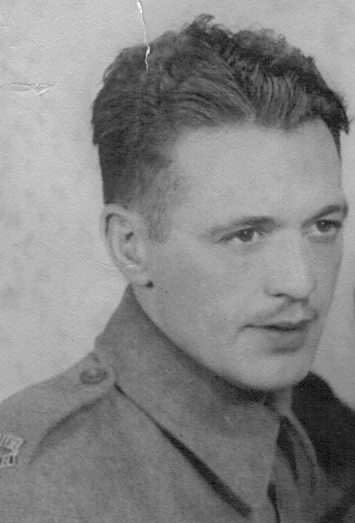
Training
After preliminary
qualifying at the Saskatoon Mounted Police Barracks, on March 22nd, 1930, I
began life in the Mounted Police. On my arrival at the Regina training
depot—which covered several acres of barrack buildings, administrative offices,
and stables for 500 horses—I was issued the various fatigues and other parade
uniforms, together with a 45 colt revolver, a 303 Lee Enfield rifle, and stable
and riding boots, Stetson, and forage cap.
The daily routine
started at 6 AM, when all 500 of the new recruits fell in for stable parade. On
arrival at the stables, we were given a horse, saddle, and universal bit. We
were then taught by competent riding masters the proper manner of grooming,
feeding, and handling the horses and equipment; the horse was your
responsibility until the course was completed. All of them were beautiful,
high-spirited animals, and we were constantly told to speak gently to them
during grooming. After stable parade, breakfast in our spacious mess hall was
at 7 AM. By that time, we had changed into dress equipment—equipment that
gleamed from a previous night's polishing. At 8 AM, after breakfast, we
commenced arms drill and practice. At noon we ate our midday meal.
During the week,
afternoons were devoted to classroom lectures on every aspect of Canadian Law
enforcement. After several months of intense training and studying during the
evenings, all 500 new recruits wrote a final exam that covered the Criminal
Code of Canada, Federal and Provincial Statutes, and the Indian Act. When the
results were posted in our barrack's entrance hall, less than half of the class
had passed. Those who did pass became members of the RCMP and took the oath of
allegiance to the Crown. I had passed with 98% on the examinations. 1
Graduation
In September 1930,
after completing my training, I was paraded in Red serge before the Assistant
Commissioner, who complimented me for the results I had achieved on my
examinations. He also handed me a train-transport requisition sending me to a
division of the Force near the Rocky Mountains. For the next couple of years, I
rode the fence-less plains for 100 miles from the big bend country to MacLeod
in Alberta. Under the supervision of the local Indian agent, my sergeant and I
patrolled the Blood-Indian Reservation day in and day out. We always patrolled
in red serge, breeches, jack boots, and spurs. Sometimes I would be away for a
week at a time, supervising their sun dances. Our job was to prevent the white
men of Whisky Gap from getting our Indian friends charged up on moonshine. Any
offenders were promptly dealt with: summarily charged, sentenced by the
presiding Indian agent, and either
heavily fined or incarcerated in the provincial gaol—or both.
Moriarty's demise
During the spring
of 1932, the Alberta provincial police became affiliated with the RCMP; because
of this I was transferred to the Calgary sub-division and placed in charge of a
police detachment south of Drumheller, which covered about 30 miles of ranch
and wheat country, with its scattered hamlets. It was during this time that I
had to deal with the shooting of Corporal Moriarty, who was in charge of
Drumheller detachment.
Under normal circumstances, I should have been the Mountie killed that day,
because the killing occurred in my district
The facts were as follows: on the day previous to the killing, a sheriff
came out from Calgary to evict a farmer from a quarter-section of land along
the Calgary trail about 7 miles from my headquarters. The farmer was a
bachelor, about 45 years old, who lived alone in his farm house, situated on
160 acres of wheat land. His name was David Knox. Three years prior to this,
quite near this quarter section, he had leased another 160 acres. His method of
farming was to allow one of the quarter sections to lie fallow, while he
planted his crop on the other.
In that particular
year, his lease had expired and the new owner had refused to renew it. When
approached by the new landlord, Knox informed him that he would not vacate the
land in question until he was paid for the improvements. Though Knox was
justified in requesting reimbursement for the plowing and harrowing of the
leased quarter section, payment was refused.
As the lease had
expired, the new landlord proceeded to Calgary and instituted the necessary
legal steps to have a writ of ejection issued and handed to the Sheriff, who
would then remove David Knox from the unlawfully possessed land. On the
following day, the Sheriff came out from Calgary to execute the writ of
ejection. David Knox met him at the wired fence gate with a 30-30 rifle in his
hand, and upon pointing it at the Sheriff, told him to get off his land or he
would kill him.
When an incident
like this happens, the next step the Sheriff takes is to contact the nearest
RCMP police detachment and refer a charge before the local justice of the peace
of pointing fire-arms to intimidate an officer of the law. My detachment was
the closest—about seven miles from Knox's farm. When the sheriff arrived, I was
absent of duty investigating a cattle rustling case. As a result, the Sheriff
proceeded in his car to the police detachment at Drumheller, which was in the
charge of corporal Mike Moriarty—a huge, robust Irishman. Mike had the charge
laid before the local magistrate and an arrest warrant issued to bring Knox in
to stand trial.
At about noon the
following day, I had concluded my cattle rustling case, and returned with my
prisoner to the detachment and locked him in the cells, pending the
adjudication of his case based upon the evidence I had secured— branded cattle
found upon the accused man's property. It was customary for me to have my meals
at the local hotel and while doing so—if the occasion demanded—bring a meal
back for any prisoners I had in the Detachment Jail. It was high noon when I
drove up to the hotel for my midday meal, and the summer weather was a trifle
hot. The heat had interfered with the proper functioning of my car's
carburetor, so I left my car to be fixed at the garage across from the hotel.
When I crossed the
street to the hotel, I noticed about a half a dozen cars parked on the dusty
road at the front, one of which was a new Chevrolet sedan. These cars usually
belonged to travelers. When I entered the hotel's dining room, I noticed about
a dozen people at the various tables. No sooner was I seated, when the hotel's
red-headed telephone operator came running into the dining room saying,
"Constable Steeves, we just got a call from someone at the filling station
out at the Calgary Trail junction, and they said that corporal Moriarty has
been shot."
I stood up and
asked all the gentlemen present who owned the new Chevrolet in front of the
hotel. A chap from the Calgary Herald—who had overheard the conversation—stood
up and said that he did. I replied, "I am commandeering your car—the
Federal Government will be responsible for any damages incurred." Sensing a news story, he asked, "May I
come along?" I said that he
could—at his own risk.
We reached the
junction of the Calgary trail in about three minutes—it was about three miles
from town. The gas station was owned by a young man named Henry Carey. His house was on the opposite
side of the Calgary Trail from the gas station. The kitchen door was open and I
saw him and his family eating their lunch. I jumped out of the car and rushed
up to his door and said "Henry, the hotel's telephone operator just told
me that someone phoned from your station saying that Corporal Mike Moriarty had
been killed."
Henry jumped to
his feet, saying, "I don't know
who phoned—I left the station about 15 minutes ago—but I bet I know who killed
Moriarty." He continued, "Yesterday morning, David Knox—who farms
five miles down the Trail by the bend—well, he put a sheriff off his property
at gun-point." He went on to tell
me that he knew all this because the sheriff had come to the station and tried
to telephone me. When he found out that I wouldn't be back until the next day,
the sheriff headed for Drumheller and, "I bet he went into to report the
matter to the Police Headquarters there. Looks like Moriarty came out today to
arrest him and probably got killed himself.”
“Sounds reasonable,” I remarked. “Let me go too, I want to see the
action.” said Henry. “Okay,” I replied, “at your own risk.”
The three of us
drove down that gravel highway at a 100 miles an hour, and just as we reached
the bend in the Calgary Trail, another vehicle rounded the high-banked road
from the opposite direction. This car was filled with six police constables
armed with bandoleers filled with bullets and rifles. Both cars stopped and the
driver of the other vehicle jumped out. I noticed several bullet holes through
his car's windshield and fenders. I knew this Mountie and I asked him what had
happened. He pointed to the Knox farm less than a hundred yards down the road;
it was surrounded by a barb wire fence and had the usual fence gate where you
had to lift the strands of wire over the fence post to gain entrance to drive a
car through. By the open gate, I could see the yellow stripes of a Mountie
lying flaked out on the ground. Then the Mountie pointed his hand at a man
running across a quarter section, over a quarter of a mile away, and said,
"There's the son of a bitch who did it."
After this brief
conversation, the six constables spread out in a line spaced approximately
fifty feet apart, and started running
across the quarter section, pursuing the fleeing murderer. I shouted to
them, "Use your heads. Where in
the hell do you think you're going?"
They continued to keep in formation, running as fast as they could.
I went over to
their bullet-riddled police car and noticed that they had left the keys in the
ignition. Turning to the reporter and Henry Carey, I said, "Swing your car
around and follow me. We'll head down to the next quarter section road—we'll be
in front of him within 5 minutes." We swung out onto the Calgary Trail,
and then turned left along the quarter-section road, passing Knox within 2
minutes. He was running about a hundred yards to our left across the
stubble—carrying a 30-30 rifle in his right hand and red bandanna handkerchief
in his left. It looked like he still had over a 100 rounds of ammunition in it.
As our two cars reached the end of the quarter section road, I turned left onto
a dusty country road and drove into a farm yard. Knox was heading for this
road, about 300 yards further up, and would have to cross it—it was bordered on
either side by barb wire fencing.
All I had with me
was a 45 colt revolver and twelve rounds of ammunition. The farmer, his wife,
and two sons—both around my own age—were sitting at the kitchen table eating
their dinner as I entered the room. Without any introductions, I pointed out
the window at Knox, saying "He just killed one of our men." I then asked if they had a rifle. They
replied in the negative. I looked out the kitchen door and saw a horse in the
corral. I asked if that was a saddle horse and if they had a saddle. They had
no saddle, but added the horse could be ridden bareback by a good rider,
because he was just two years old. Peeling off my spurs, Stetson, and police
jacket, I said to one the boys, "Go out and put a bridle on that
horse." And to the other son I said,
"Take your coveralls off, I am going to ride up to him and arrest
him."
In a few moments,
I was in the coveralls and on that frisky horse’s back, directing him at a slow
canter up the road. I could see Knox and could tell that he was constantly
looking backwards at the other policemen who were chasing him—they were still
hundreds of yards behind him and out of shooting range. When I reached the
point where I figured he would cross the two-strand, barbed-wire fence, he was
still a 100 feet on the other side of the fence.
When he spotted me
on horse back, he slowed to a fast walk and I had to hold my mount in to meet
him in the center of the road. When he reached the fence, I was within 20 feet
of him. I had anticipated that he would take me—dressed as I was in overalls—as
a farm hand. In my right overall pocket, I held my hands high and elbows close
in to cover the protruding handle of my 45 colt revolver. When Knox stepped
over the fence, he crossed the road, facing me with his rifle pointed directly
at my face.
I stared right
back and then I realized from the wild gleam in his eyes that the man was off
his rocker. I had handled many insane people in the course of my police work,
and of his condition then, I had no doubt. According to my plan, I had assumed
that when he spotted me, he would think I was another farmer—like himself—and
that his rational move would have been to say "Young fellow, jump off that
horse." I saw myself sliding off
the horse's back and handing him the reins, while at the same time, grabbing
his rifle and disarming him—and that's all there would be to it—except,
snapping the handcuffs of him, which I had in the hip pocket of my inside
breeches.
Get the picture,
my horse is still approaching Knox as he moves within ten feet across the road
with me staring down into the rifle bore of his 30-30. Under my breath I am
saying to myself, "Lord, I got millions of sins—forgive them!" As I passed him, I looked to the right over
my shoulder and observed Knox parting the middle of the three strand fence on
the opposite side of the road, in doing so, he caught the back of his shirt on
the second wire strand. And I thought sure as hell, if I fire now, this horse
is going to throw me and before I can get to my feet, he will nail me that
rifle. He was a dead shot.
In a minute, he
negotiated the fence crossing, then moved down a sloping ravine. And as his
head disappeared, I swung the horse around and gave it one hell of a kick in
the rear haunches to get it heading for the farm yard about three hundred yards
down the road. All the others who had accompanied me, together with the farmers
family, were standing in the farm yard watching—they later told me that when
Knox emerged out of the stubble ravine, he put the rifle to his shoulder and
pointed it at me, sprawled out on that galloping horse.
It was really
amusing: I had lost control of the reins and my hands were round the horses
neck with my 45 colt dangling from my clinging fingers and the left side of my
body riding the right flank of my galloping steed. Upon reaching the farm yard,
I peeled off the coveralls and replaced them with my Jacket, Stetson and spurs,
and while doing so, instructed Henry Carey to cut across the stubble and find
the nearest policeman with a rifle.
In the meantime,
another constable arrived and we both jumped into the police car and tore
through the stubble up to a fence; there, we commenced shooting at Knox who
returned our fire ....
[Note: my dad
again ends his story here abruptly. Too bad. I remember that he had wanted to
write a best-seller, and believed that because his stories were exciting he had
a sure thing. One day, he took his book off to be read by someone who,
evidently, my Dad believed was knowledgeable in what it took to write a
best-seller. I don’t know who it was, but when Dad came back, he said something
like “It’s no good.” And he put the
book away and stopped working on it. I asked my Mom about this and she said
that it was just like him to do that—“He couldn’t stay with anything for longer
than a few months.”]

Appendix 1:
Procedural plan of contents of Life on the Ragged Edges
(this is a draft plan for his book
that Dad wrote)
1. Joudry’s Lane
2. Edouard Magee. Goose Eggs and
Crows Eggs and Cousin Watson Lutes
3. Reading Tarzan stories and what
happened to Dad's beaver coat
4. West Lane Swimming hole and the
Ferguson Boy drowning. Bill Lutes drowning.
5. Age 13 years. Church. The Bell
boys and my first real fight. Trapping rats.
6. Mr. R. G. Warman skinning the cat
at the science class.
7. Meeting Roy Ramey, Armenian
expression "ullet eye" meaning full of life.
8. School holidays with Roy and
pit-lamping, shooting cow, reward offered.
9. Banking days, Bill, Edwar, myself
and brother Frank, all bankers.
10. Kiting checks. Always getting
money from Dad to pay them.
11. Smashing the car. Dad making me
pay every cent back covering cost of the car.
12. First experience of seeing Red
coated Mounties in Moncton on harvest train.
13. Late 1920's to Boston and
Richmond and the wonderful people of the south.
14. Malaria fever and return home and
applying to join Royal Mounted Police.
15. I say good-bye to Father and
Mother and go west on harvest excursion.
16. My first experience with spike
pitching and hay racks and wild horses.
17. Good times in Saskatoon after we
got paid off from the harvest. Employed by Woolworth's and meeting my elderly
cousins who had cattle ranch.
18. Meadow Lake stampede and the
cattle ranch and fun had riding and duck shooting.
19. Sand trapping foxes and tramping
out two hundred fifty miles behind fish swing. Blowing the trapping loot and
joining the Mounted Police. [written note: Can of tomatoes and Squaw.]
20. Training in Regina. Lethbridge,
Indian reservations, National Parks. The gals from Hollywood that offered to
buy my discharge from the force. Boxing with Tony Casanero, holder of three
world titles and the Chew of Tobacco and she unseating me in the saddle and
dumping me in the river.
[written note: and inspector and card game]
21. Take-over by the Mounted Police
of the Provincial Police in Alberta in 1932.
22. Experiences on Drumheller mining
town detachment. Demise of Corporal Moriarty. Meeting Hap Ross and free
enterprise venture into wheat, hogs and cattle and the Inspector....... Demise
of Mrs. Nazarek and elusive killer never found.
23. The bull that nearly killed an
Indian and forced by police to sell cattle.
24. Foxes on the upper Mackenzie and
arranging transfer there to make money.
(this, I believe, is a second,
more-complete plan that he wrote)
Dec. 29th, 1960. This is the lay-out
of a procedural plan for a best seller of 1962.
This series of true short stories
adapted from the adventuresome life of the author are a condensation of the
Book size novel entitled Life on the Ragged Edges.
Part 1. Joudry's Lane
Part 2. A Junior Chancellor of the
Exchequer - as a bank clerk. Shot the Jersey cow for deer
Part 3. The straw that broke the
camel's back.
Part 4. An immigrant enters U.S.A.
Part 5. A Voluntary Departure from
the U.S.A.
Part 6. Back in the Bank again.
Determination to enlist in the Mounties.
Part 7. Harvest trains rolling
westward.
Part 8. Cattle Ranching. Would Come
Back One Day.
Part 9. Trapping Foxes in Northern
Saskatchewan.
Part 10. Return to the Outside.
Part 11. Regina Barracks R.C.M.P.
Part 12. On Patrol in Southern
Alberta.
Part 13. Calgary Sub-division -
1. The grey eye & 1 brown eye killer of Mrs. Nazarek
2. Conscience of a Fledgling mother.
3. Dum-Dum Heart Burst that blew life out of Moriarty.
4. The 3 Roaster Sisters.
Part 14. Cattle on the Hoof. Dice
game.
Part 15. Northern Detachment Service.
Playboy my lead dog.
Part 16. Return to Prairie Police
Patrol
Part 17. A Man's Man. Colonel W. F.
W. Hancock - Superintendent R.C.M.P.
Part 18. Declaration of Hostilities.
Part 19. Britain 1939-42. Period of
Inactivity.
Part 20. Mediterranean Theatre of
War.
Part 21. Convalescence - A Pledge to
the men who came not back.
Part 22. Northern Italy Night
Fighting Patrols. Beer - Broads and Battle.
Part 23. London: Nov. 1945.
Part 24. My experience as a Poultry
Farmer in British Columbia. Hen and I.
Part 25. England in Post War. 1947.
Part 26. Vacuum of Political Lethargy
in Canada 1949. First Venture.
Part 27. Stepping Stones Toward
Fulfillment of Ultimate Aims and Objectives.
Part 28. Philosophy of the Sixties.
(I recall that when I was in Junior
High Dad interested again in writing his book.
There was his usual frenzy of typing in the basement, and this might be
the time when he showed it to someone and returned saying that it was no
good. Anyway, what follows is an
introduction he wrote when he was in his pitch of excitement — certain that his
life of adventures was something everyone wanted to read about.)
Commencement, September 26, 1970
Introduction
Playboy
The short stories in this book are based upon the life experiences of a former
member of the Mounted Police from adolescence as a mischievous boy in the green
house on Joudry’s Lane in Moncton, New Brunswick to the far flung expanse of
the upper Mackenzie River district with that king of lead dogs — Playboy —
whose intelligence and fortitude in face of adversity in that land of the
midnight sun was frequently to be recalled to the memory of the writer on those
hazardous night-fighting patrols into the enemy lines during the Allied
offensive of the Second World War.
(One time, Dad was pretty pissed and
I guess my Mom was out. And he
described to me one of his night-fighting patrols. “The German sentry was marching up and down and up and down. And I came up behind him and grabbed him and
drove the knife right into his back ...)
© Jon F. Steeves
1999. All Rights Reserved.